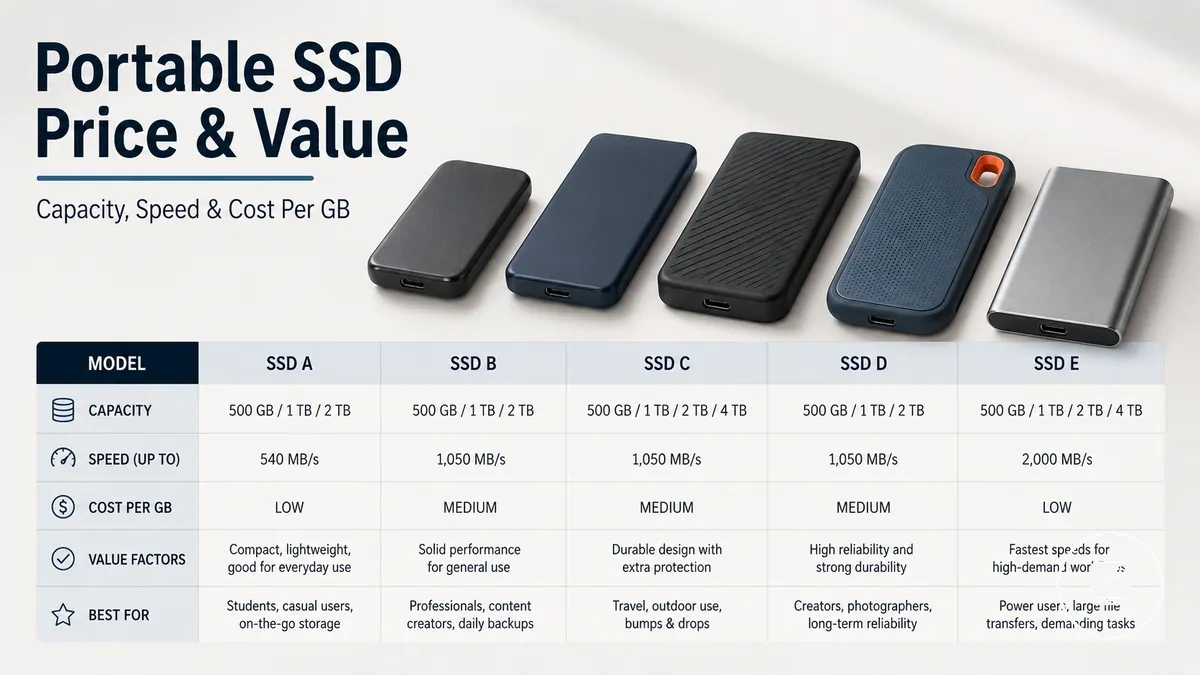
Portable SSD Price and Value for Capacity, Speed, and Cost per GB Decisions
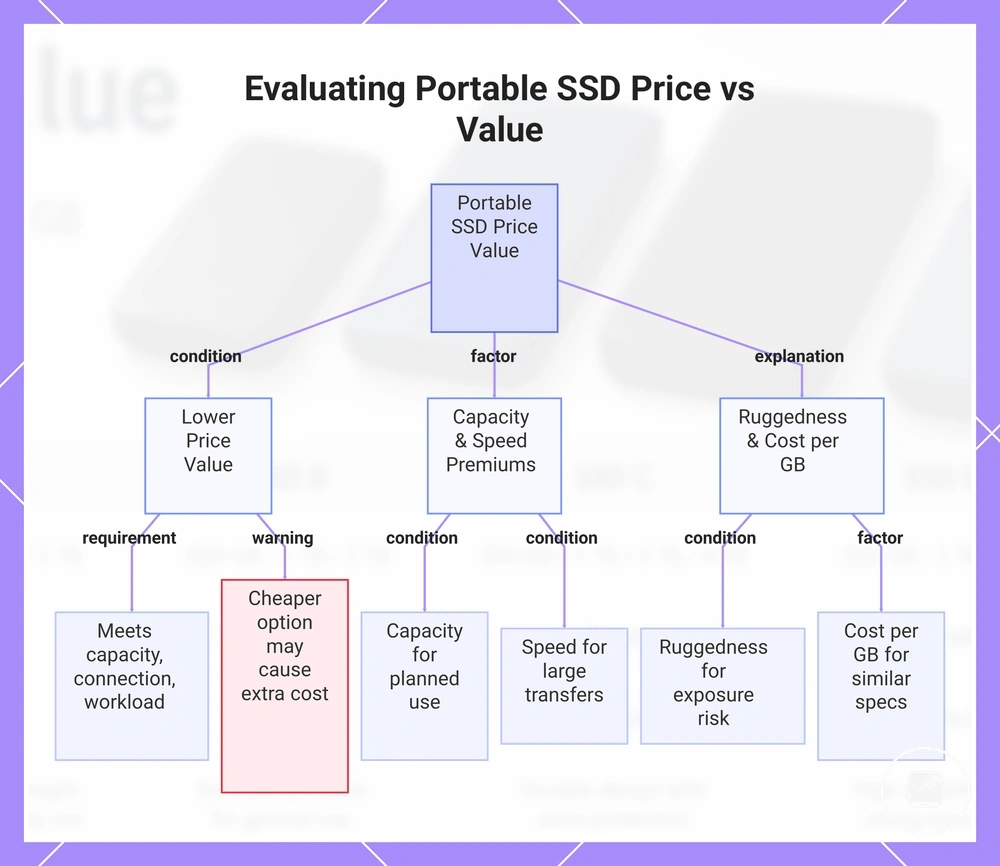
A portable SSD provides good value when its price matches the usable capacity, practical speed, build quality, and features required by the buyer’s workload and budget. A low upfront price reduces immediate spending, while long-term practical value comes from paying only for storage performance and protection that will be used.
Cost per GB is more favourable when a higher-capacity drive provides usable storage that the buyer is likely to fill rather than leave unused.
Cost per GB is more favourable when a higher-capacity drive provides usable storage that the buyer is likely to fill rather than leave unused. A speed premium is justified when the interface and workload can use the additional real-world performance; otherwise, the faster speed class adds cost without a matching benefit. Paying more for ruggedness can reduce damage risk during frequent travel or field use, while the same feature premium offers less practical value for a portable SSD used mainly at a desk.
A speed premium is justified when the interface and workload can use the additional real-world performance; otherwise, the faster speed class adds cost without a matching benefit.
For example, a traveller moving large media files may gain more practical value from higher capacity, a suitable speed class, and a durable enclosure, while an occasional document-backup user may reduce purchase risk by choosing a lower-priced drive with sufficient storage rather than unused performance. The stronger price-to-value decision therefore balances budget against intended use, usable capacity, practical speed, and handling conditions without treating price alone as the deciding factor.
Table of Contents
What Makes a Portable SSD Worth the Price
A portable SSD is worth the price when its capacity, speed, build quality, and compatibility serve the buyer’s workload better than a cheaper option. The higher price has practical value when those differences reduce transfer time, protect frequently moved storage, or prevent connection and capacity problems. A cheaper option remains sufficient when it meets the same workload without unused performance or features.
A cheaper option remains sufficient when it meets the same workload without unused performance or features.
What makes a portable SSD worth the price is the fit between its value criteria and the buyer’s actual use. The annotated image labels the capacity, speed, build quality, and compatibility factors that justify or weaken the price difference. portable SSDs are compact external storage drives whose practical value comes from matching storage, performance, physical protection, and connection requirements to the intended workload.
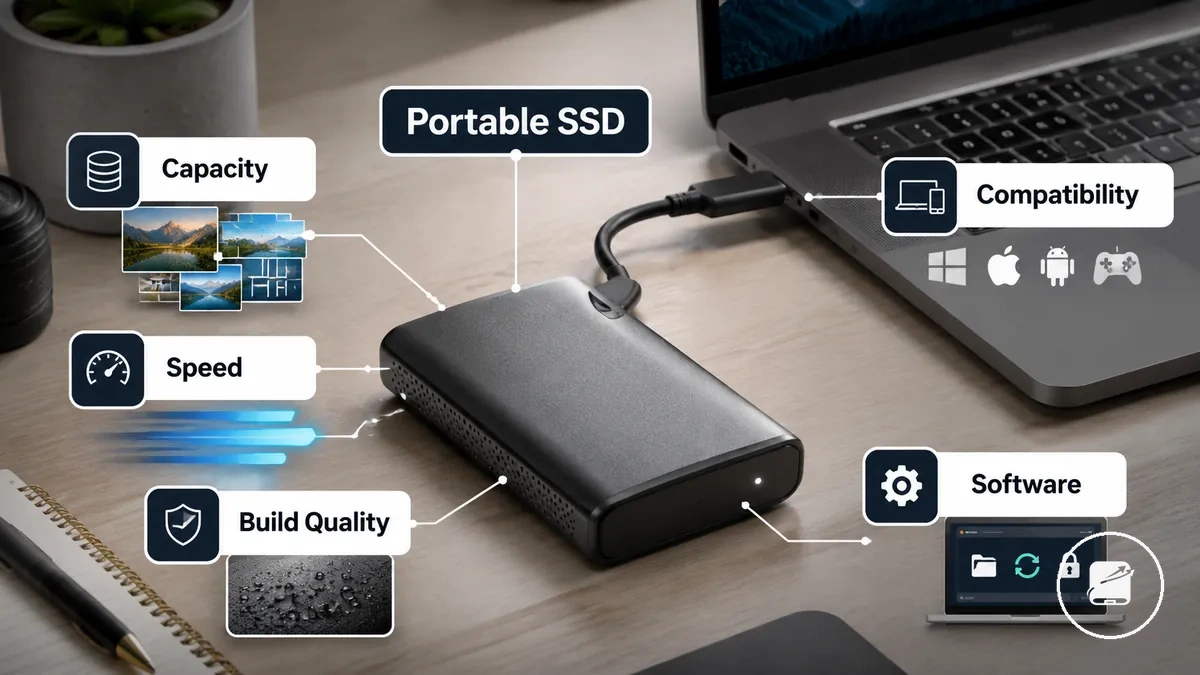
- Capacity: The selected capacity should hold the expected files with enough working space for growth; paying for substantially more unused storage reduces practical value.
- Speed: Higher transfer speed is worth paying for when the workload regularly moves large files or runs storage-intensive tasks; occasional document backup may not benefit enough to justify the premium.
- Build quality: A durable enclosure has greater value for frequent travel and field use because it lowers physical-damage risk, while desk-based storage places less demand on rugged construction.
- Compatibility and cable fit: The drive and cable should match the device’s connector type and supported interface; a mismatch can require an adapter, restrict performance, or prevent a usable connection.
- Warranty: Longer or clearer coverage adds value when its protection period and exclusions match the expected ownership period; narrow coverage provides less purchase-risk reduction.
- Software features: Backup, encryption, or management software is worth a premium only when the buyer’s workflow uses that function; an unused software feature adds cost without a practical benefit.
For example, a backup user may obtain sufficient value from dependable capacity and compatible cabling, while a frequent traveller benefits more from durable build quality and relevant warranty coverage. A high-transfer user may justify a faster storage drive when repeated large-file movement makes the time saving meaningful, but the cheaper option remains appropriate when the workload is light and infrequent.
Portable SSD Cost per GB and Capacity Value
Cost per GB helps compare portable SSD capacity tiers by showing how much advertised storage each price provides, but the lowest per-gigabyte cost is not automatically the best purchase. Capacity value is strongest when the selected tier supplies enough usable storage and spare capacity for the expected storage workload. A low upfront price can lose practical value if the drive fills too soon during the ownership period.
Calculate cost per GB by dividing the portable SSD price by its advertised capacity in gigabytes.
Calculate cost per GB by dividing the portable SSD price by its advertised capacity in gigabytes. The result is most useful when comparing drives within the same price tier and market period, because it measures storage-price efficiency rather than how much capacity the buyer will actually use. A lower result indicates more advertised capacity per unit of price, while unused capacity increases overbuying risk.
A lower result indicates more advertised capacity per unit of price, while unused capacity increases overbuying risk.
The comparison graphic and table show how portable SSD capacity changes the balance between per-gigabyte efficiency, usable storage, and workload fit. The 1TB, 2TB, and 4TB rows describe general capacity-value tendencies rather than fixed prices or universal recommendations.
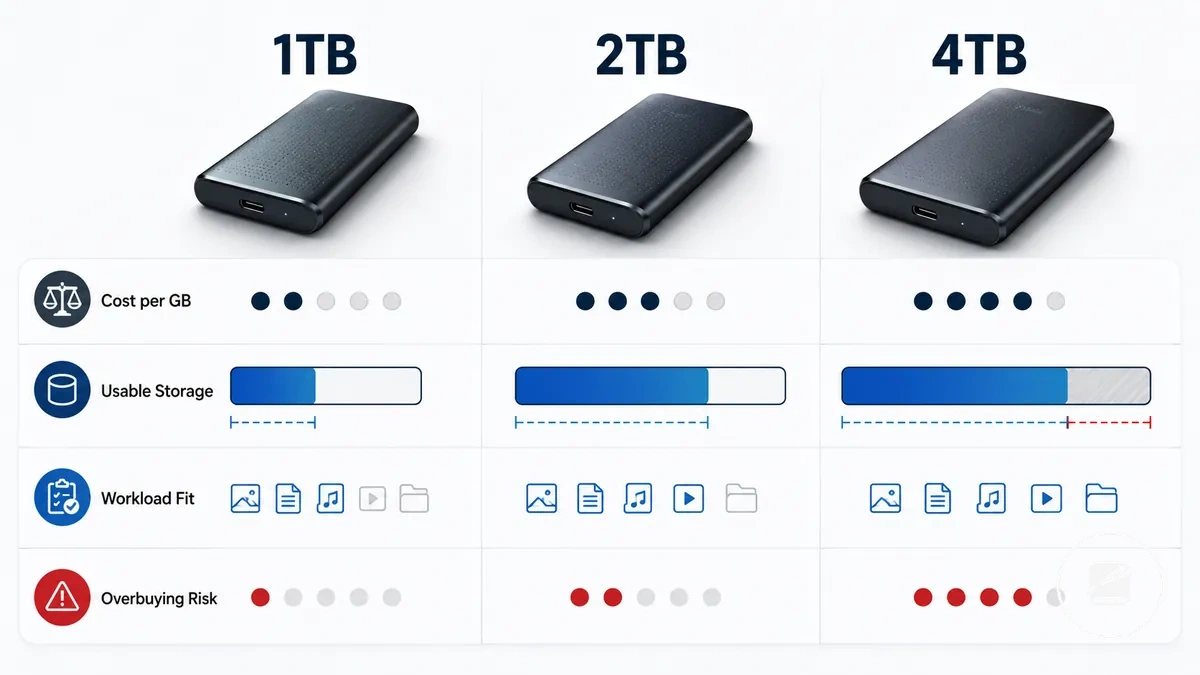
| Capacity tier | Cost-per-GB tendency | Best fit | Overbuying risk |
|---|---|---|---|
| 1TB | Higher per-gigabyte cost than larger tiers when price scaling favours capacity | Light or moderate storage workload with limited growth | Lower when most of the usable storage will be occupied |
| 2TB | Middle-ground per-gigabyte cost within common capacity comparisons | Regular backups, growing file collections, or mixed workloads | Moderate when future storage growth is uncertain |
| 4TB | Lower per-gigabyte cost when the price increase is smaller than the capacity increase | Large storage workload with sustained file growth | Higher when a substantial share of the capacity remains unused |
A larger capacity tier lowers long-term storage cost only when the spare capacity is likely to be used before the drive is replaced. For example, a user with a growing archive may obtain practical value from 4TB, while a user storing documents and occasional backups may avoid overbuying with 1TB or 2TB even when the larger drive has a lower cost per GB.
1TB, 2TB, and 4TB Value Differences
The value of a portable SSD capacity tier changes with storage needs rather than cost per GB alone. A 1TB drive generally offers a lower upfront price for light storage, while 2TB and 4TB provide more storage headroom in exchange for a higher price level and different overbuying risk.
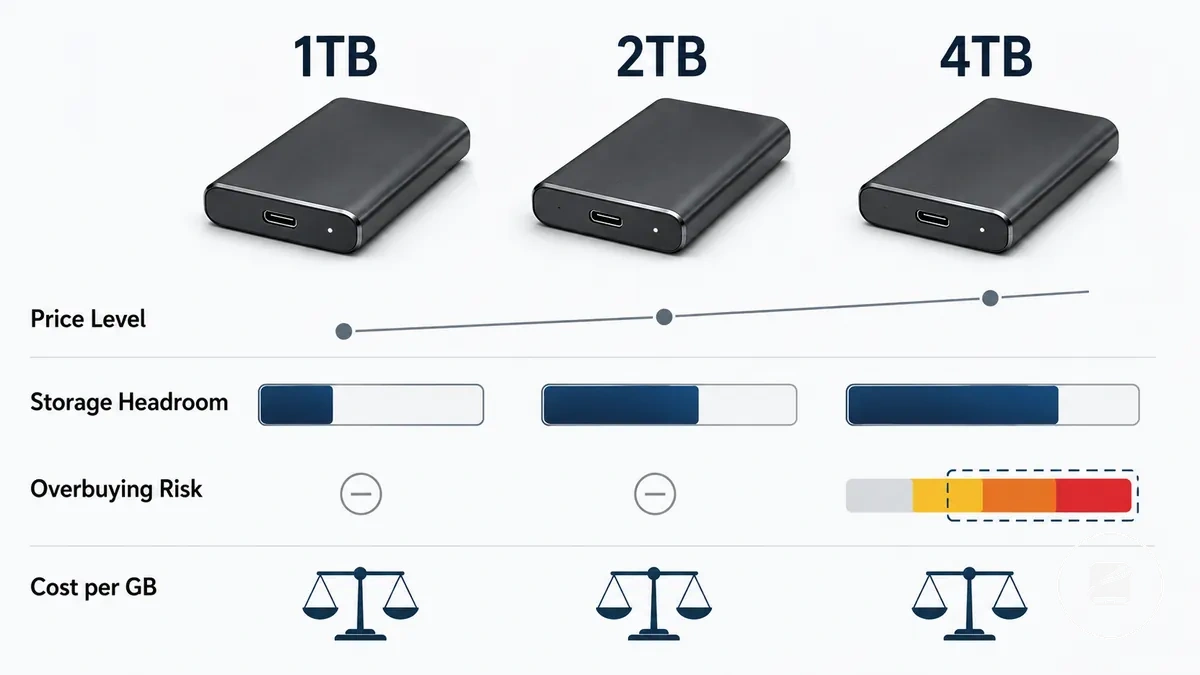
The table compares each capacity tier as a local cost-per-GB decision instead of treating one option as universally better. For example, a user storing mainly documents may gain little benefit from unused 4TB capacity, whereas someone maintaining a growing media library could make better use of the additional spare space.
| Tier | Value strength | Trade-off | Best use case |
|---|---|---|---|
| 1TB | Lower upfront price with suitable value for light storage workloads | Less storage headroom and a higher chance of filling sooner | Documents, everyday files, and moderate backups |
| 2TB | Balanced capacity tier with additional spare space and competitive cost per GB | Higher price level than 1TB | Mixed files, regular backups, and steadily growing storage needs |
| 4TB | Largest storage headroom and often the strongest cost per GB when capacity will be used | Highest upfront price level and greater overbuying risk if much of the storage remains unused | Large media libraries, creative projects, and sustained storage growth |
When Larger Capacity Lowers Practical Storage Cost
Larger capacity lowers practical storage cost when spare capacity is likely to be used during the ownership period. Predictable file growth, frequent backups, and increasing storage demands can delay replacement pressure, while light storage use increases the risk of paying for unused space.
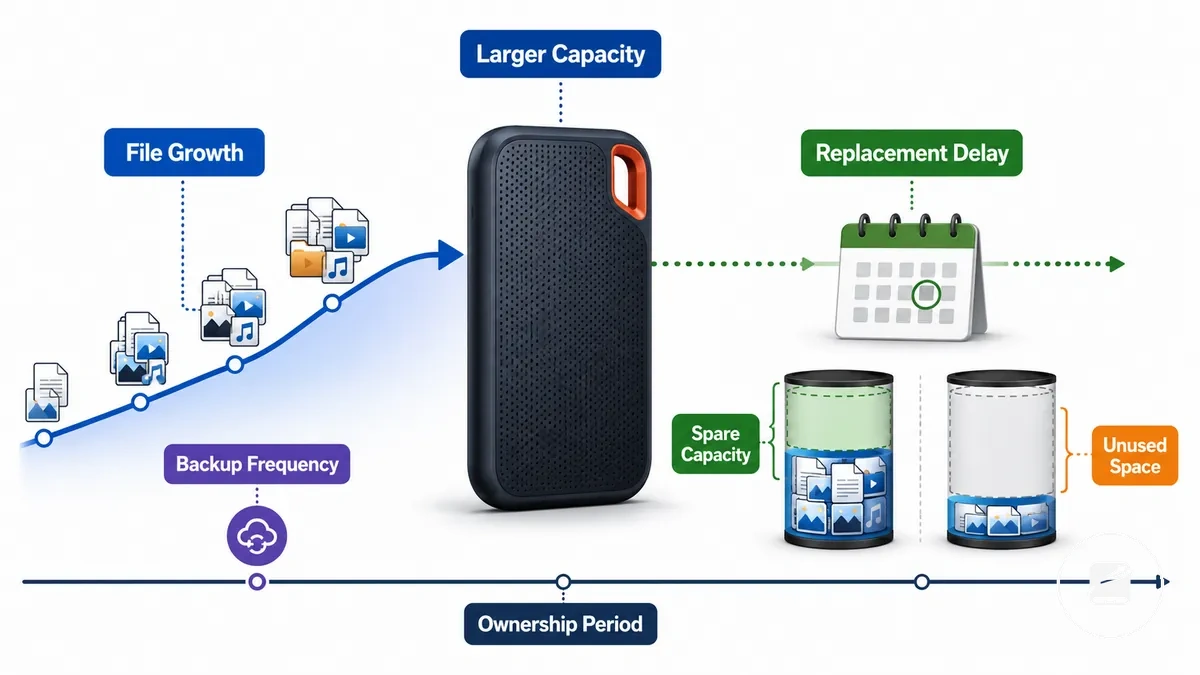
The diagram highlights how storage growth influences long-term value rather than promising fixed savings. For example, a growing photo or video library can benefit from extra storage headroom over time, whereas a drive used mainly for documents may leave much of a larger capacity unused.
- Supports larger-capacity value: Predictable file growth is expected throughout the ownership period.
- Supports larger-capacity value: Higher backup frequency benefits from additional spare capacity and reduces drive juggling.
- Supports larger-capacity value: Extra storage headroom lowers replacement pressure as storage needs expand.
- Weakens larger-capacity value: Light storage workloads leave unused space, increasing the risk of overbuying.
Speed Premiums and Practical Performance Value
A speed premium delivers practical performance value only when the portable SSD's higher transfer rate can be used by the device interface, cable, file size, and workload. Advertised speed reflects the drive's maximum capability, while real-world speed is limited by the slowest component in the transfer path, which can either save time or become a wasted premium.
For a detailed explanation of these limits, see portable SSD speed .
The interface and cable set the upper limit for practical performance, so a high-speed portable SSD provides additional value only when both support higher transfer rates and the workload benefits from them. The same drive can perform differently when connected through a slower interface or cable because the connection becomes the bottleneck. For a detailed explanation of these limits, see portable SSD speed.
The same drive can perform differently when connected through a slower interface or cable because the connection becomes the bottleneck.
The table below contrasts advertised speed with practical performance by showing how common speed-related factors influence real-world value.
| Speed factor | Limiting condition | Value effect |
|---|---|---|
| Speed rating | Device interface supports a lower transfer rate than the SSD | Higher advertised speed cannot be fully used because the interface becomes the bottleneck. |
| Interface | Older or slower connection standard | Practical performance is capped even if the SSD is capable of higher speeds. |
| Cable | Cable supports lower data throughput than the drive | The cable limits sustained transfer, reducing the value of the speed premium. |
| Sustained transfer | Large files copied continuously | Higher sustained transfer can reduce waiting time during extended file transfers. |
| Workload | Routine backups or light workloads with mostly small files | The speed premium often provides limited practical value because file handling, rather than peak transfer rate, becomes the primary limit. |
For example, editing large video projects or moving large media libraries repeatedly can make higher sustained transfer worthwhile because time savings accumulate across frequent transfers. By contrast, routine backups, document storage, or light workloads usually receive little additional benefit when interface limits, cable capability, or file characteristics prevent higher advertised speeds from being fully used.
When Higher Transfer Speed Is Worth Paying For
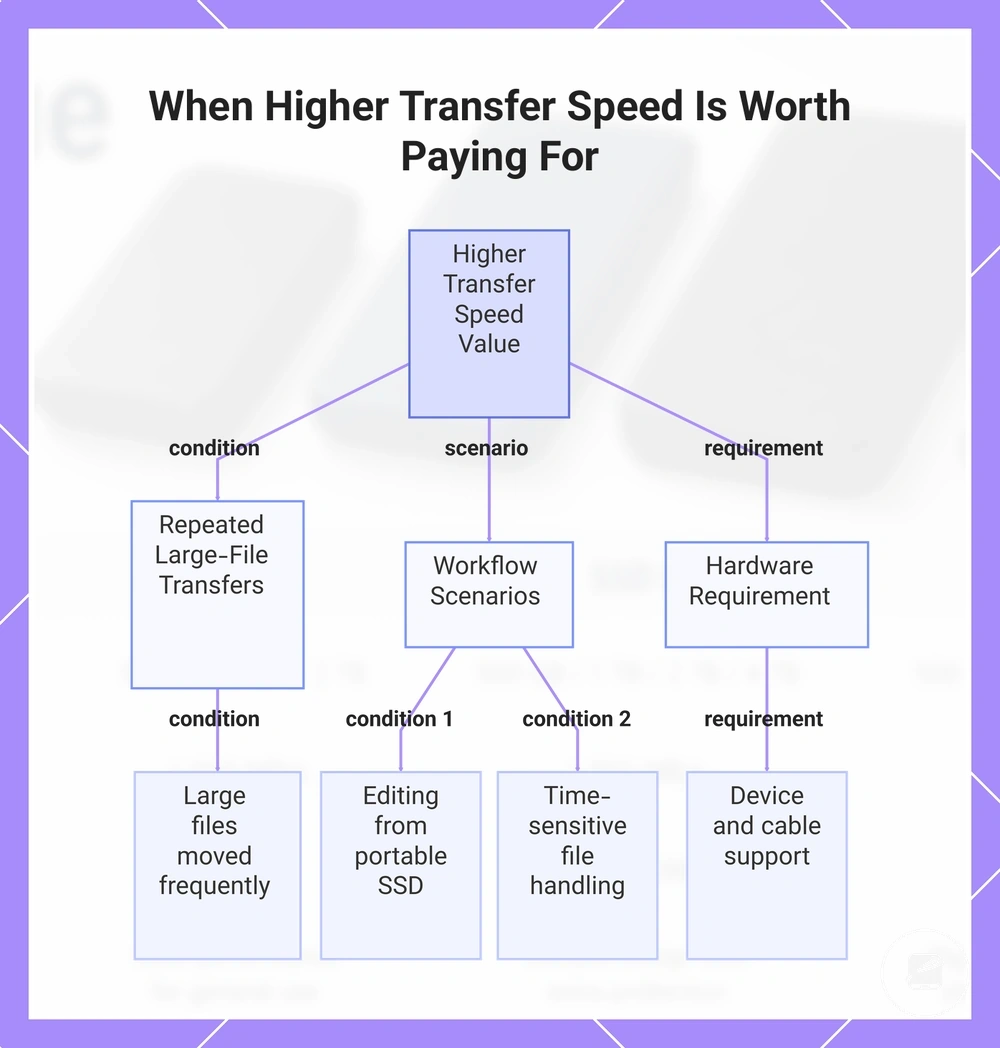
Higher transfer speed is worth paying for when the workload involves large files, repeated transfers, and compatible hardware that can use the faster connection. Under those conditions, the speed premium can reduce recurring transfer delays and improve the workflow; light or infrequent transfers provide less opportunity for meaningful time saved.
- Repeated large-file transfers: Higher speed has more value when large media folders, backups, or project files are moved frequently because the transfer-time reduction recurs across the workload.
- Editing from the portable SSD: Faster transfer can improve the workflow when media files are accessed directly from the drive and the editing device supports the required data rate.
- Time-sensitive file handling: A high-speed SSD is more useful when files must be copied, reviewed, or delivered repeatedly within a limited working period.
- Compatible hardware: The device interface and cable must support the drive's higher transfer speed; otherwise, the slower connection limits the practical value.
For example, a user who regularly moves large video projects between compatible devices is more likely to benefit from higher transfer speed than someone who stores documents or performs an occasional routine backup. The deciding condition is whether file size, transfer frequency, editing location, and a fast interface combine to create a repeatable workflow gain.
The deciding condition is whether file size, transfer frequency, editing location, and a fast interface combine to create a repeatable workflow gain.
This chart shows the key conditions that make higher transfer speed worth the premium, including workload characteristics, workflow scenarios, and hardware requirements.
When Advertised Speed Adds Little Usable Value
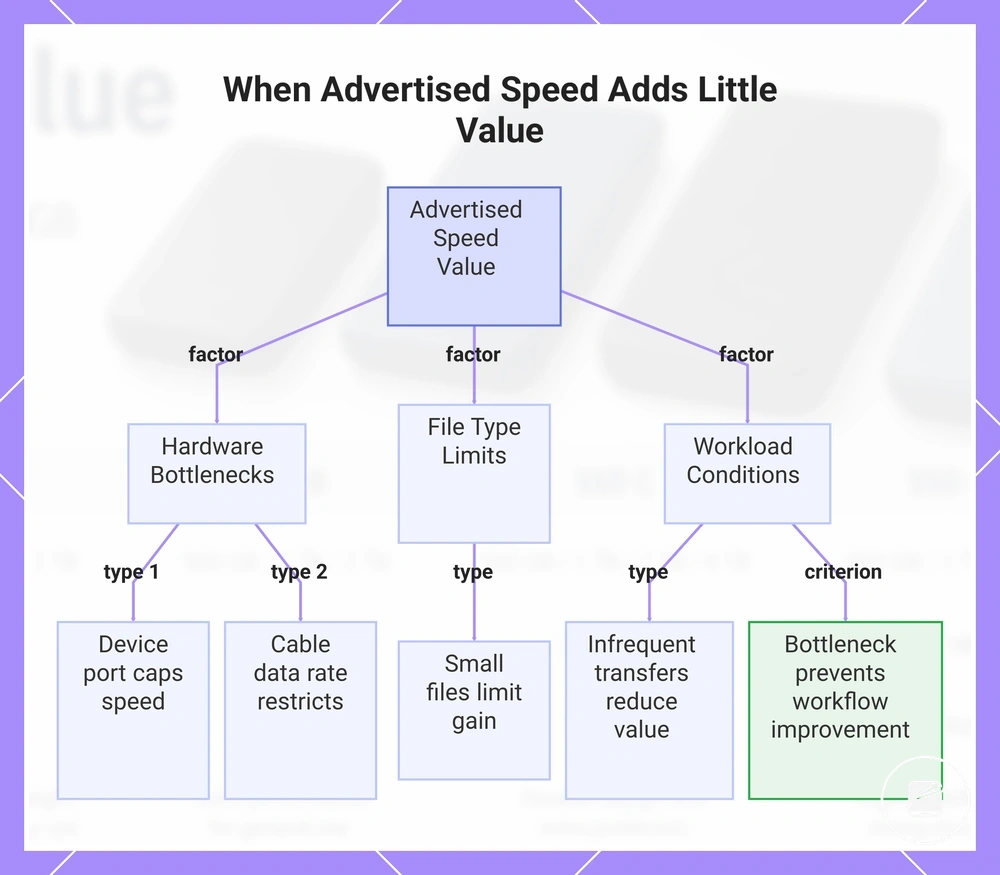
Advertised speed can add little usable value when a bottleneck prevents a portable SSD from reaching its rated performance. The speed premium is weakest when the device port, cable, file type, or light workload limits practical speed before the drive's higher capability can improve everyday use.
- Device port limit: A slower device port caps transfer performance, reducing the practical gain from the SSD's advertised speed.
- Cable bottleneck: A cable with a lower supported data rate than the drive restricts real speed and weakens the value of the premium.
- Low-demand file type: Small documents and routine file storage create little gain because peak transfer speed has a limited effect on short, light transfers.
- Light workload: When transfers are infrequent or not time-sensitive, allocating more of the budget toward capacity can provide greater usable value than paying for a higher rated speed.
For example, a buyer who mainly stores office files through a slower device port is likely to receive less practical benefit from higher advertised speed than from additional capacity. The deciding criterion is whether a speed-limited setup or light workload creates a bottleneck that prevents the premium from producing a meaningful workflow improvement.
The deciding criterion is whether a speed-limited setup or light workload creates a bottleneck that prevents the premium from producing a meaningful workflow improvement.
This chart shows the main bottlenecks that prevent a portable SSD's advertised speed from providing usable value, and the deciding criterion for when to prioritize capacity over speed.
Ruggedness and Feature Premiums in Portable SSD Pricing
Feature premium is the additional cost of protective or convenience features beyond storage capacity and transfer speed. Ruggedness, reinforced casing, water resistance, encryption, bundled cable options, and software features add value only when they reduce a realistic risk or remove everyday friction for the intended workload.
Feature premium is the additional cost of protective or convenience features beyond storage capacity and transfer speed.
Ruggedness increases price because a durable build, protective casing, and a tested water resistance rating are designed to reduce risk during travel rather than guarantee protection. By contrast, desk use usually benefits less from these features, while encryption provides greater value on shared devices and a bundled cable improves compatibility when the required connection is not already available.
For a broader comparison of physical protection, see rugged portable SSD value .
The table below compares common feature premiums with the situations where they provide meaningful value. For a broader comparison of physical protection, see rugged portable SSD value.
| Feature | Added cost reason | Useful when | Skip when |
|---|---|---|---|
| Ruggedness and reinforced casing | Protective design and improved resistance to everyday handling risks | Frequent travel or mobile work | Mainly desk use with minimal handling |
| Water resistance | Protective sealing supported by a tested rating | Incidental exposure to rain, dust, or outdoor conditions is a realistic risk | Indoor storage and occasional backup |
| Encryption | Additional data security feature | Shared devices or portable storage containing sensitive files | Personal use where extra access protection is unnecessary |
| Bundled cable and software feature | Improved compatibility and added convenience | Multiple devices or workflows that benefit from included accessories or utilities | Existing compatible cables and no need for additional software |
Choose feature premiums according to the risks you actually expect rather than treating every extra as equally valuable. For example, a frequent traveller may benefit from ruggedness, while a user performing occasional home backups often gains more value by allocating the same budget toward additional storage capacity instead of unused premium features.
Portable SSD Price Ranges and Value Positions
A portable SSD price range is most useful when read as a value position rather than a fixed market boundary. Budget, balanced, and premium tiers represent different trade-offs in capacity, practical speed, durability, and feature depth, so the suitable buyer is defined by workload fit rather than price alone.
A portable SSD price range is most useful when read as a value position rather than a fixed market boundary.
A budget value position prioritises a lower upfront price and baseline speed, with fewer durability or software extras; it suits occasional backup and light file transfer, but offers less headroom for demanding workflows. A balanced position combines practical speed, useful capacity, and reduced compromise for regular users, while a premium position adds advanced features or higher performance for workloads where those gains are used often enough to justify the greater overpayment risk.
The comparison below shows how each value tier should be interpreted conceptually because actual price ranges change by market, capacity, and model.
The comparison below shows how each value tier should be interpreted conceptually because actual price ranges change by market, capacity, and model.
| Value position | Strength | Compromise | Best fit | Watch-out |
|---|---|---|---|---|
| Budget | Lower upfront price with baseline portable SSD performance | Less capacity choice, feature depth, or durability protection | Occasional backup, document storage, and light transfers | A low price can become poor value if limited capacity or speed forces an early upgrade |
| Balanced | Practical speed, useful capacity, and a moderate feature set | Does not maximise either the lowest cost or the highest performance | Regular transfers, general work, and buyers seeking reduced compromise | The extra cost is unnecessary when the workload remains light enough for a budget tier |
| Premium | Higher performance, stronger protective features, or advanced workflow support | Higher purchase cost and greater overpayment risk | Frequent large transfers, professional workflows, or repeated travel exposure | Advanced features add little value when the device port, workload, or usage pattern cannot use them |
Move up a value position when the next tier removes a specific constraint, such as insufficient capacity, repeated transfer delays, or realistic travel risk. Move down when the higher tier adds features without a matching workflow gain; for example, an occasional backup user is usually a more suitable buyer for a budget or balanced tier than for a premium option built around sustained performance and advanced extras.
Budget Portable SSD Value
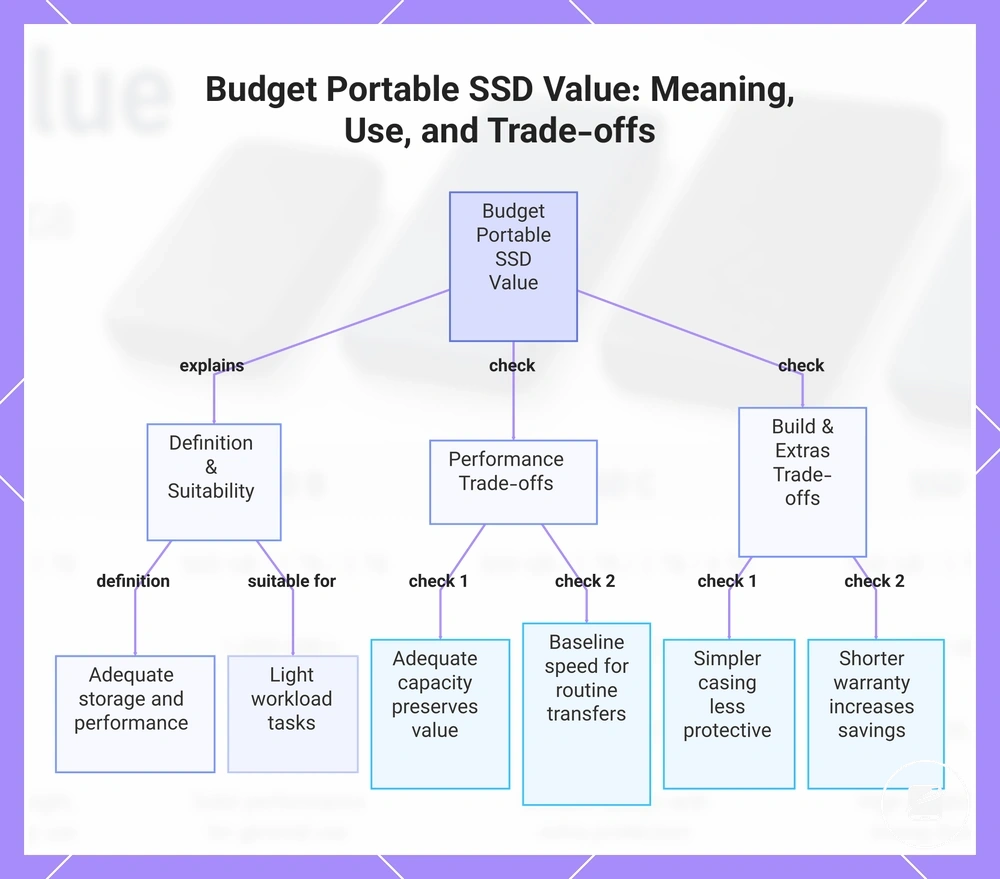
Budget portable SSD value means choosing adequate storage and acceptable performance at a lower upfront price instead of paying for maximum speed or ruggedness. It is most suitable for a light workload, such as routine file storage, document transfer, or occasional backup, where baseline speed is sufficient for the task.
The savings usually come from simpler construction, narrower capacity choices, or fewer included features rather than from one universal reduction in quality.
The savings usually come from simpler construction, narrower capacity choices, or fewer included features rather than from one universal reduction in quality. Check these trade-offs before deciding whether the budget position fits the intended workload:
- Capacity: Adequate storage preserves value when it holds the expected files without forcing an early replacement, while unused excess capacity reduces the practical savings.
- Baseline speed: Acceptable performance suits routine transfers, but repeated large-file work can make a higher-speed option more appropriate.
- Casing: A simpler casing can reduce cost, but it provides less protective value when frequent travel or rough handling creates a realistic risk.
- Warranty and accessories: A shorter warranty or fewer included cables and software extras can increase savings, but missing accessories become a compromise when they must be obtained separately.
This chart explains the concept of budget portable SSD value, its best use cases, and the key trade-offs to consider before purchasing.
Balanced Portable SSD Value
Balanced value refers to a portable SSD that keeps capacity, practical speed, reliability cues, and price in proportion for common storage needs. It reduces decision risk by avoiding underbuying, where everyday workloads outgrow the drive, and premium waste, where higher-cost features provide little practical benefit. For example, routine backups, photo libraries, and regular file transfers can benefit from this balance when maximum performance is unnecessary.
For example, routine backups, photo libraries, and regular file transfers can benefit from this balance when maximum performance is unnecessary.
Use this checklist to assess whether a balanced portable SSD value matches the intended workload:
- Capacity: Select enough storage for current files and expected growth without paying for unused space.
- Practical speed: Choose transfer performance that supports routine work efficiently instead of paying for throughput the device or workload cannot fully use.
- Reliability cues: Check for a durable casing, an appropriate warranty, and consistent build quality because these features help reduce decision risk for common storage needs.
- Workload fit: A proportional price is justified when the drive meets everyday storage requirements without creating underbuying or premium waste.
Premium Portable SSD Value
A premium portable SSD provides value only when advanced speed, ruggedness, larger capacity, encryption, or stronger build quality solves a real usage constraint. The higher price is justified when those features create a measurable workflow gain or reduce an identified risk; otherwise, the premium becomes unnecessary extra cost. For example, frequent large-file transfers or regular travel can justify a premium tier more clearly than occasional document backups.
For example, frequent large-file transfers or regular travel can justify a premium tier more clearly than occasional document backups.
Use this checklist to distinguish a justified premium from unnecessary overbuying:
- Advanced speed: The premium is justified when repeated large-file transfers limit productivity and faster transfer performance shortens that recurring task; it is unnecessary when the workload consists mainly of small or infrequent files.
- Larger capacity: Higher capacity adds value when a heavy workload would otherwise require multiple drives or frequent file removal; unused excess capacity does not create a workflow gain.
- Ruggedness and build quality: A rugged design supports risk reduction when regular travel, field use, or repeated handling exposes the drive to a higher chance of impact or environmental stress.
- Encryption: A security feature is worth the added cost when the drive stores sensitive data or is used as a shared device; it adds limited value when the stored files are non-sensitive and access remains controlled.
Matching Portable SSD Value to Storage Use Cases
A storage use case determines which portable SSD attributes provide practical value because backup, travel, media work, and general file storage place different demands on capacity, speed, ruggedness, and cost. Matching those attributes to the workload reduces the risk of paying for features that do not improve the intended storage need.
The main variables are storage volume, transfer frequency, portability risk, device fit, and budget pressure.
The main variables are storage volume, transfer frequency, portability risk, device fit, and budget pressure. For example, backup usually places greater emphasis on capacity and reliability, while media work places greater emphasis on speed and capacity because files are transferred more frequently.
The use-case matrix below identifies the value priority for each scenario and distinguishes attributes worth paying for from those that may add unnecessary cost.
The use-case matrix below identifies the value priority for each scenario and distinguishes attributes worth paying for from those that may add unnecessary cost.
| Use case | Value priority | Attribute to pay for | Attribute to avoid overpaying for |
|---|---|---|---|
| Backup | Capacity and reliability within the available budget | Enough capacity for the planned backup volume and dependable construction | Maximum speed when transfers are infrequent and not time-sensitive |
| Travel | Lower portability risk and practical device fit | Ruggedness, compact dimensions, and a cable connection that fits the carried devices | Excess capacity or speed that the travel workload will not use |
| Media work | Frequent transfer performance and working capacity | Speed and capacity that match repeated large-file handling | Extra ruggedness when the drive remains in a controlled workspace |
| General file storage | Balanced value and practical fit | Capacity that matches routine documents, photos, and mixed files | High-end speed or protection features without a recurring use condition |
Choose the value emphasis that matches the user scenario rather than treating every premium attribute as necessary. Reassess capacity, speed, ruggedness, device fit, and budget pressure when the workload changes so the portable SSD remains aligned with practical storage requirements.
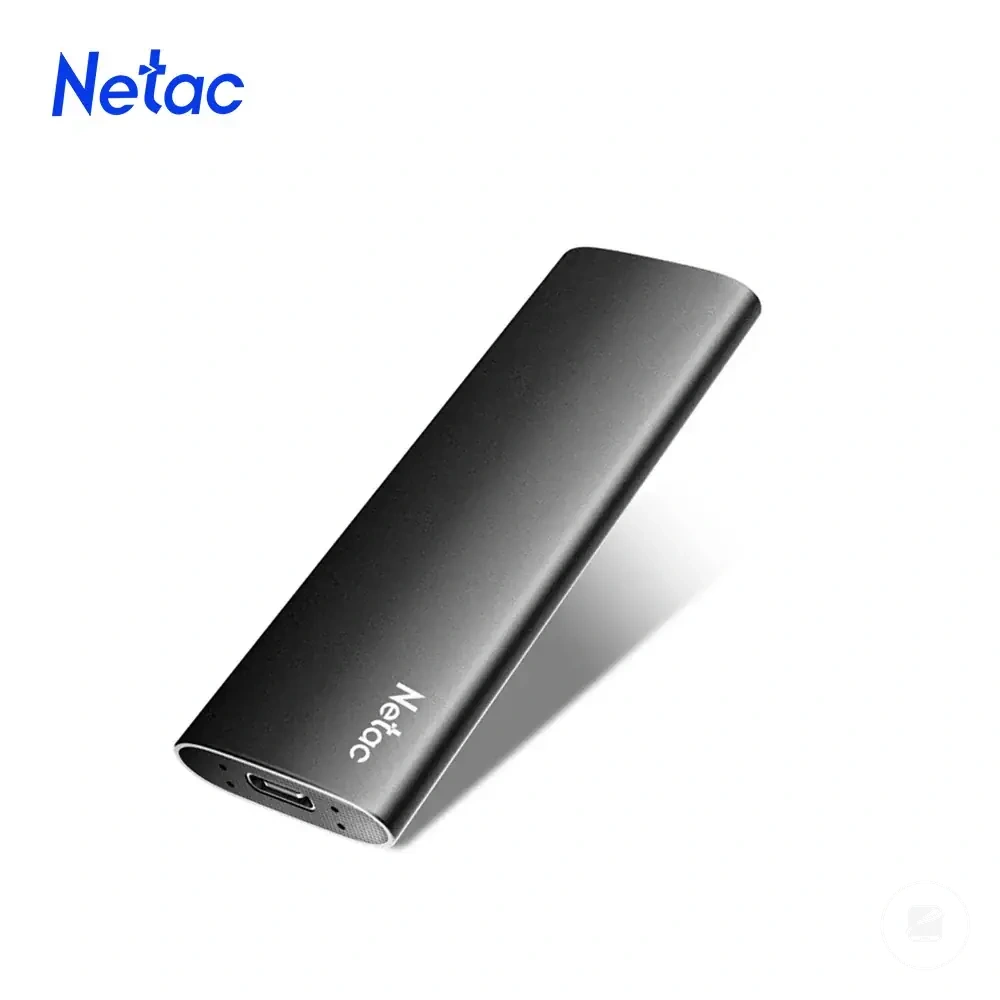
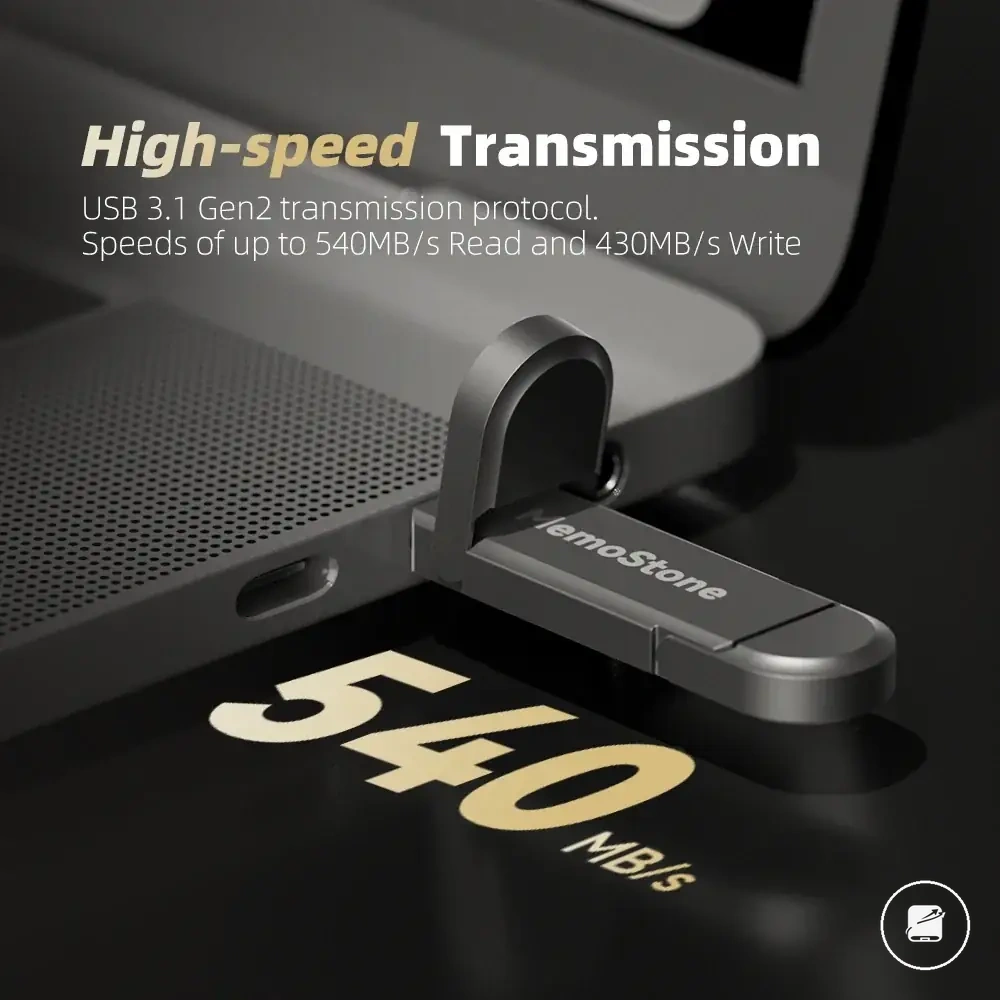
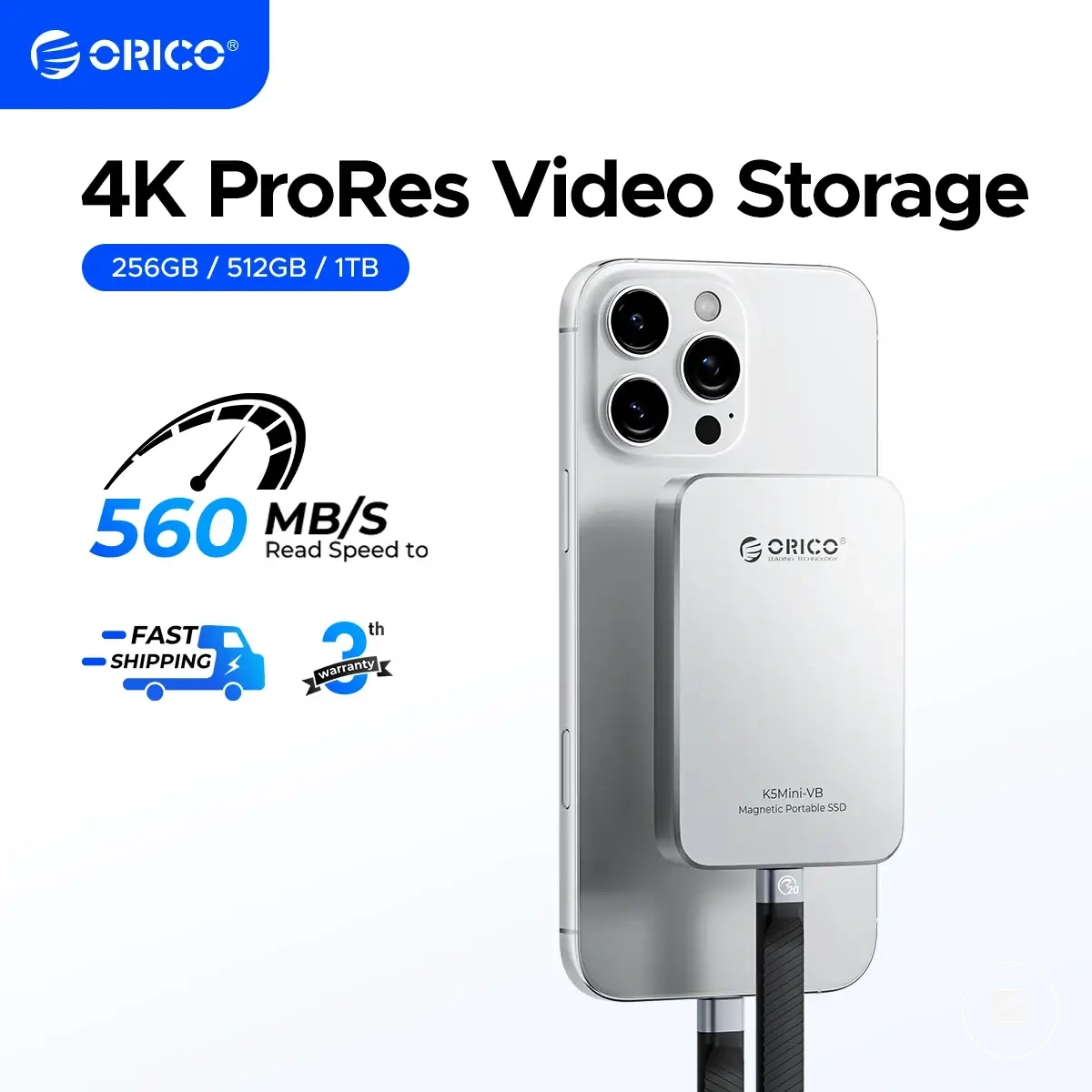
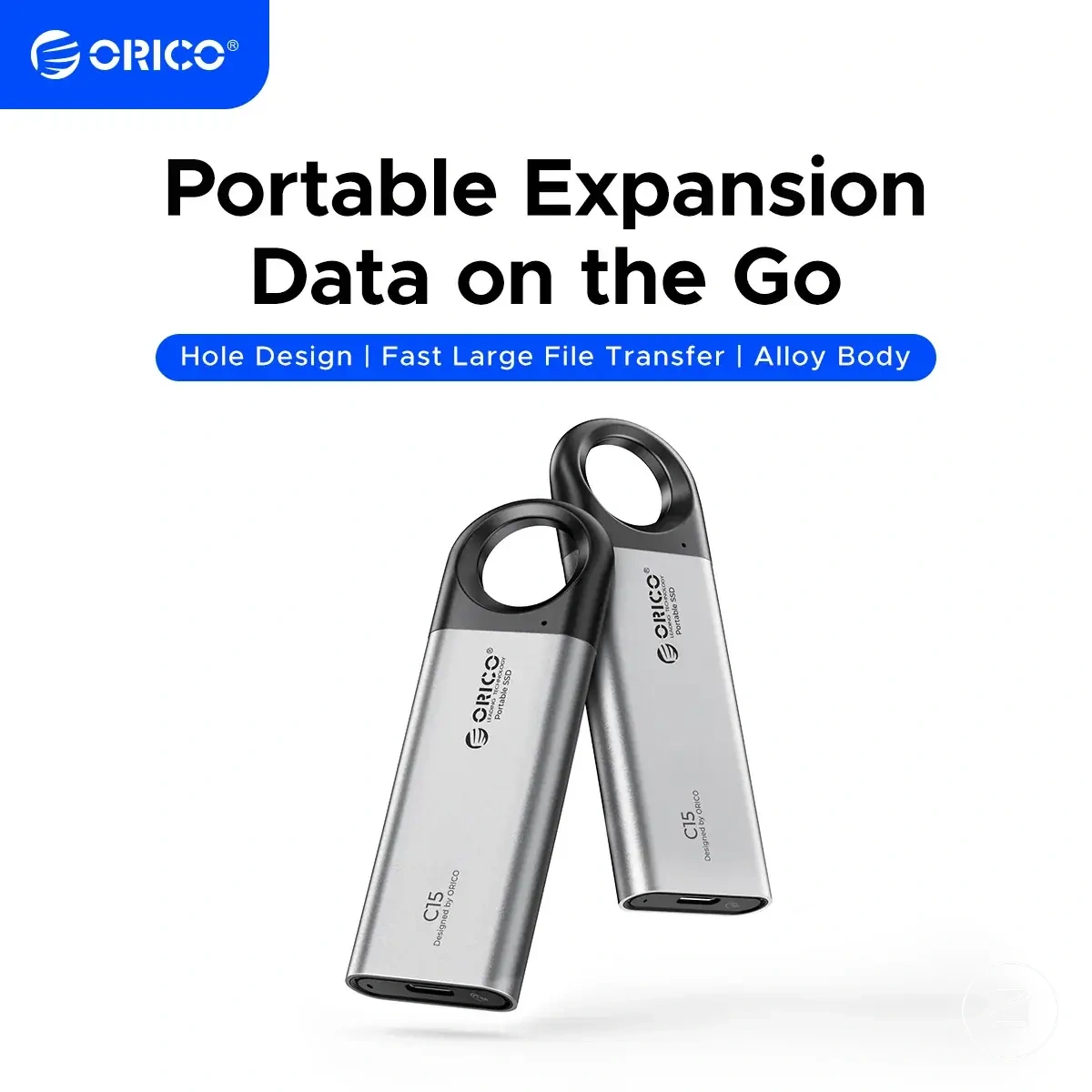
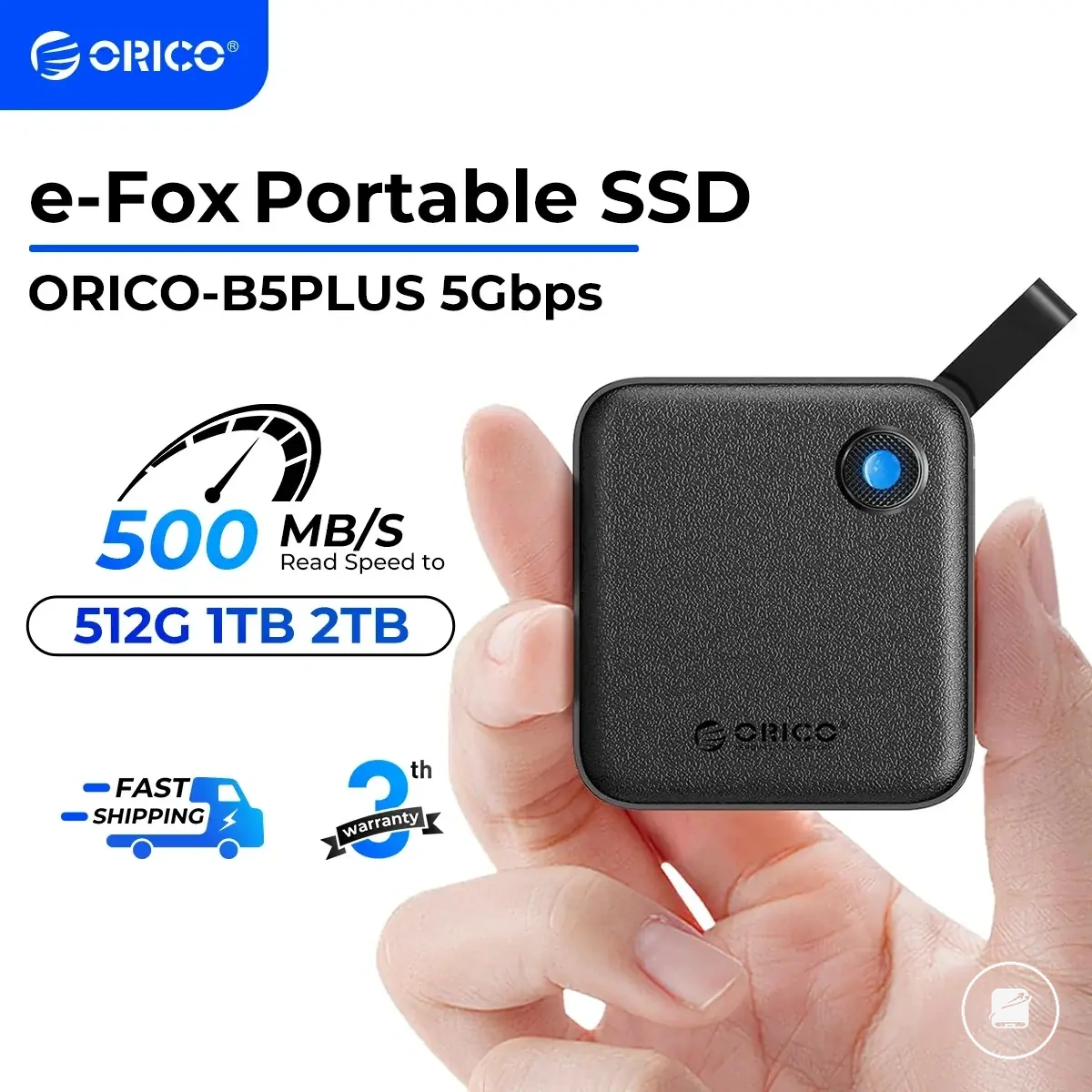
The products below are useful examples for comparing available options.
The products below are useful examples for comparing available options. Before buying, check that the compatibility criteria, key features, and product details match your needs.
How to Compare Portable SSD Prices Without Overpaying
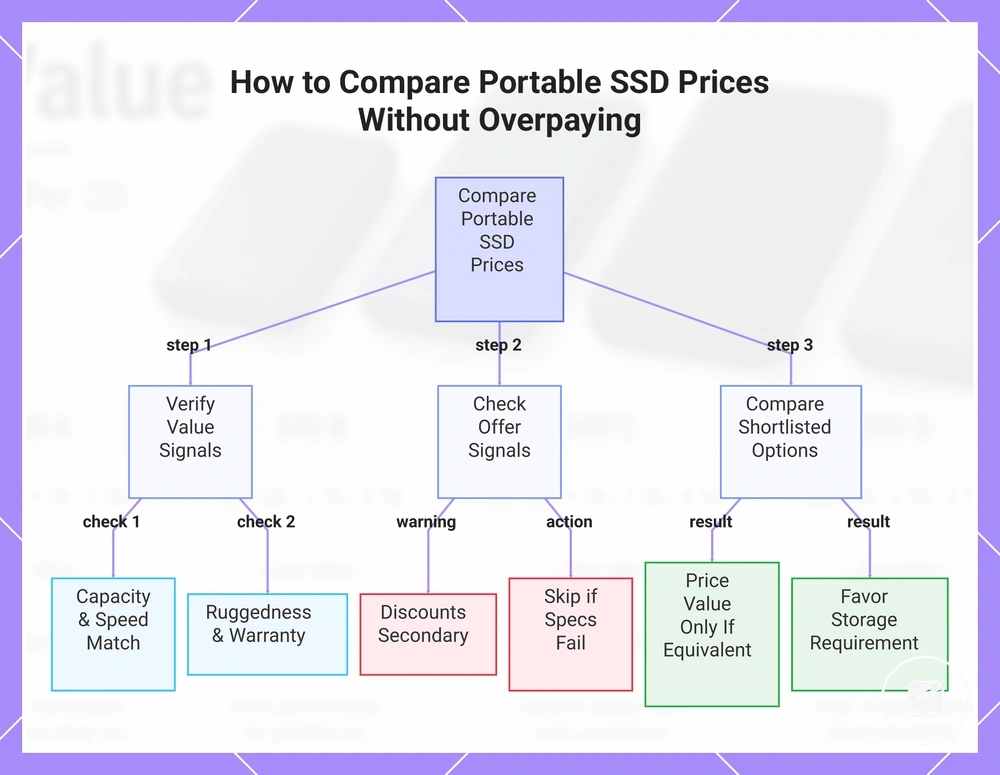
To compare portable SSD prices without overpaying, verify the storage value you need before considering discounts or other offer signals. Shortlist a drive only when its required capacity, practical speed, connectivity, and protection features match the intended workload.
Shortlist a drive only when its required capacity, practical speed, connectivity, and protection features match the intended workload.
Value signals describe what the portable SSD contributes to the decision: enough capacity for the planned files, speed suited to the transfer frequency, ruggedness proportional to portability risk, a clearly stated warranty, compatible cables, and the full accessory cost. Offer signals should remain secondary because a lower advertised price does not correct mismatched specifications or missing accessories.
Offer signals should remain secondary because a lower advertised price does not correct mismatched specifications or missing accessories.
Use this buying checklist before comparing offers, then shortlist or skip each option according to the verified criteria:
- Required capacity: Confirm that the storage category matches the current file volume and expected growth; skip excess capacity that has no planned use.
- Practical speed: Match the performance tier to the actual transfer frequency; avoid paying for higher speed when transfers are small or infrequent.
- Ruggedness need: Pay for added protection when regular travel or field handling creates a defined portability risk; skip the premium for controlled desk use.
- Warranty: Compare the stated warranty period and coverage conditions rather than treating the warranty label alone as equal value.
- Cable compatibility: Verify that the included connector fits the intended computer, phone, tablet, or console; otherwise include the required adapter or replacement cable in the decision.
- Accessory cost: Add the cost of any necessary cable, adapter, case, or hub to the compared price before creating a shortlist.
- Offer check: Treat urgency messages or discounts as secondary; skip an offer when the final specification or total cost fails the verified value signals.
Compare the final shortlisted options on the same capacity, practical speed, ruggedness need, warranty scope, cable compatibility, and accessory cost. A lower price represents better value only when those conditions remain equivalent; otherwise, favour the option that meets the storage requirement without unnecessary premiums.
Before buying, check that the compatibility criteria, key features, and product details match your needs.
The products below are useful examples for comparing available options. Before buying, check that the compatibility criteria, key features, and product details match your needs.
This chart shows the three-step checklist to compare portable SSD prices: verify value signals, check offer signals, and compare shortlisted options to avoid overpaying.
Residual Price Questions Before Choosing a Portable SSD
A residual price question should be resolved by comparing the portable SSD with the required workload rather than treating price alone as proof of value. Each value doubt is market-dependent and use-case-dependent because capacity, speed, protection, and available offers affect the practical outcome.
Is a lower portable SSD price always better value?
No, a lower price offers better value only when the drive still meets the required capacity, connection, and workload conditions. A cheaper option with insufficient usable storage or an unsuitable interface can create extra cost through adapters, replacement, or an earlier upgrade. Compare equivalent specifications before treating the price difference as meaningful.
Should I pay more for a higher-capacity portable SSD?
Pay more for capacity only when the additional usable storage has a planned purpose within the expected ownership period. A larger drive can reduce cost per GB, but the lower ratio does not create value when much of the capacity is likely to remain unused. For example, extra capacity for recurring backups has a clearer value than spare space without a defined workload.
Does a speed premium improve portable SSD value?
A speed premium is worth paying when the workload includes frequent large-file transfers and the connected device can use the higher performance tier. The premium has less practical value for occasional document storage or small transfers because transfer time is already a minor part of the task. Compare the drive interface with the host connection before paying for speed the device cannot use effectively.
When is a ruggedness premium justified?
A ruggedness premium is justified when travel, field work, or frequent handling creates a clear exposure risk. Added protection has lower value for a portable SSD that remains on a desk or inside a protected case in a controlled environment. The decision should match the expected risk rather than treating rugged construction as a universal requirement.
What does cost per GB reveal about portable SSD value?
Cost per GB shows how much of the purchase price is allocated to each unit of advertised capacity, but it does not measure speed, durability, compatibility, or warranty coverage. Use it to compare drives with similar specifications under the same market conditions rather than unlike products. A lower cost per GB supports value only when the additional capacity is usable and the portable SSD still fits the intended workload.
Use it to compare drives with similar specifications under the same market conditions rather than unlike products.
This chart shows the key conditions and justifications for determining whether a portable SSD's price offers real value based on workload, capacity, speed, protection, and cost per GB.