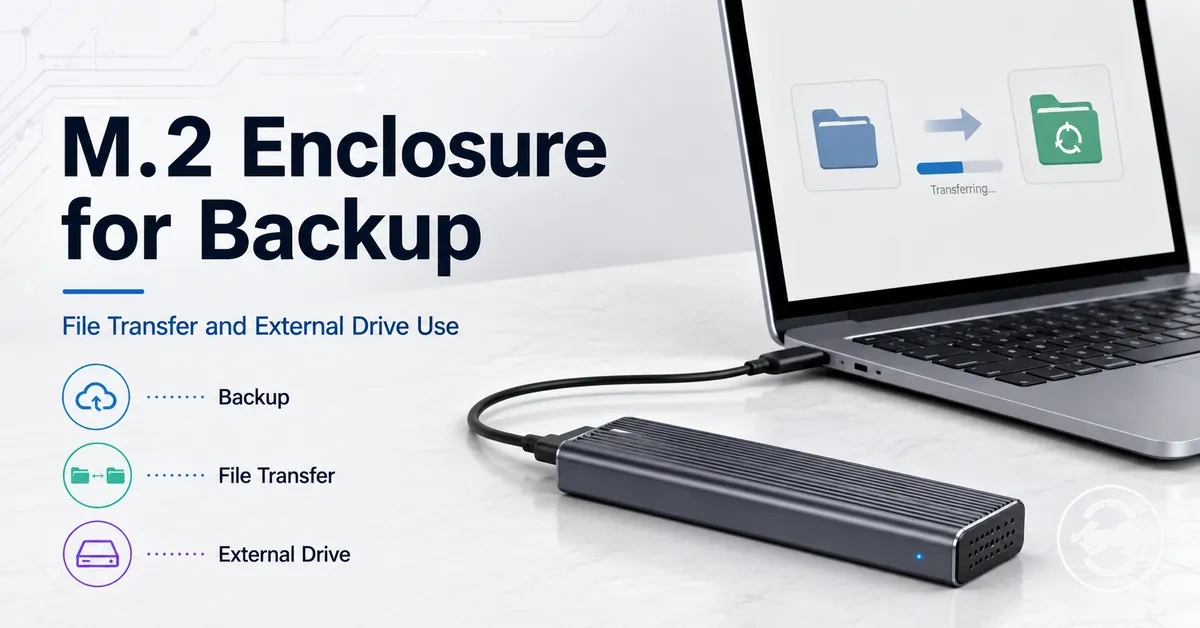
M.2 SSD enclosure as external storage for backup and file transfer
An M.2 SSD enclosure is a way to use an internal M.2 drive as external storage for backup and file transfer when the enclosure, drive compatibility, USB connection, host device, and formatting conditions are suitable. It can turn a compatible M.2 SSD into portable storage for moving or storing files, but the result depends on the complete storage path rather than the enclosure alone.
A spare SSD can often be reused in an M.2 SSD enclosure to create an external drive for portable storage, file transfer, or backup copies. This approach can be useful when an existing internal M.2 drive matches the enclosure requirements and the connected device can recognize the storage. An enclosure-based external drive is different from a dedicated external SSD because the drive, enclosure, cable, and setup conditions are selected separately.
An M.2 SSD enclosure makes sense when the backup frequency, file transfer workload, transfer speed expectations, and reliability habits match the way the storage will be used. Large files, portable copies, and moving data between compatible devices depend on factors such as the SSD type, USB-C connection path, cable quality, host port, formatting, and file system readiness. The following sections focus on these conditions and how they affect practical use.
Portable storage is not automatically a complete backup solution because reliability depends on the drive condition, connection setup, and how the backup process is managed. Checking the enclosure, internal M.2 drive, cable, host device, and formatting status helps create a more suitable setup before regular backup or file transfer use.
How an M.2 SSD enclosure works as external storage
An M.2 SSD enclosure works as external storage by connecting an internal M.2 drive to a host device through an external connection path. The M.2 SSD enclosure contains the drive connection and bridge controller that allow the internal M.2 drive to be accessed as external storage when the drive type, USB connection, formatting, and compatibility conditions are suitable.
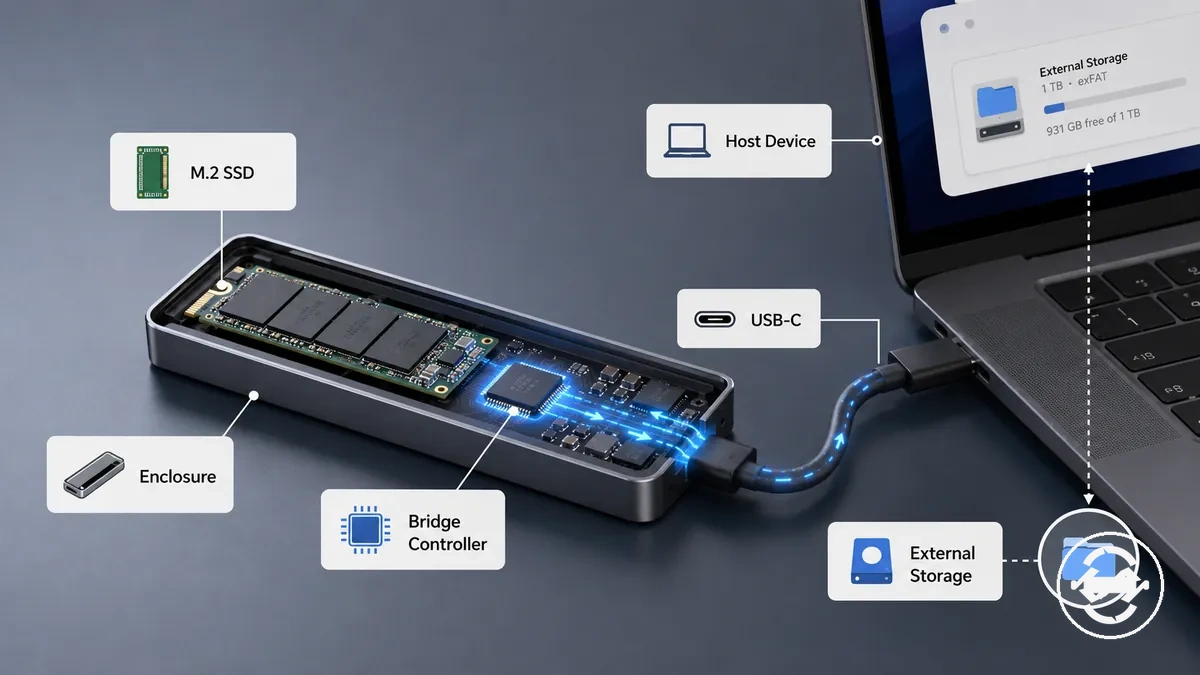
The role of what an enclosure does depends on the complete storage path rather than the enclosure body alone. The M.2 SSD enclosure works with the internal M.2 drive, bridge controller, cable or port connection, and host device to create an external storage setup.
The M.2 SSD enclosure is the main connection point, while SSD type, enclosure controller, USB connection, cable, host port, file system state, and drive condition can affect recognition and use. A compatible setup may allow the host device to access the internal drive as an external drive for supported storage tasks.
An M.2 SSD enclosure provides a way to access an internal M.2 drive externally, but the enclosure alone does not guarantee backup safety, high transfer speed, or universal compatibility. Recognition and practical use depend on factors such as drive support, file system readiness, host device compatibility, and the connection path.
When an M.2 SSD enclosure makes sense for backup
An M.2 SSD enclosure makes sense for backup when the goal is to create portable copies, reuse an existing SSD, or move files with a setup that matches the drive condition, portability needs, and risk tolerance. It can be a practical option for temporary backups or portable storage when the enclosure, SSD, connection path, and reliability expectations fit the intended use case.
Backup suitability depends on the way the storage will be used rather than the enclosure alone. An existing SSD inside an M.2 SSD enclosure may provide a convenient external backup drive for occasional copies, travel use, or file transfer between compatible devices. The decision depends on factors such as drive condition, file system readiness, formatting, and the reliability expected from the setup.
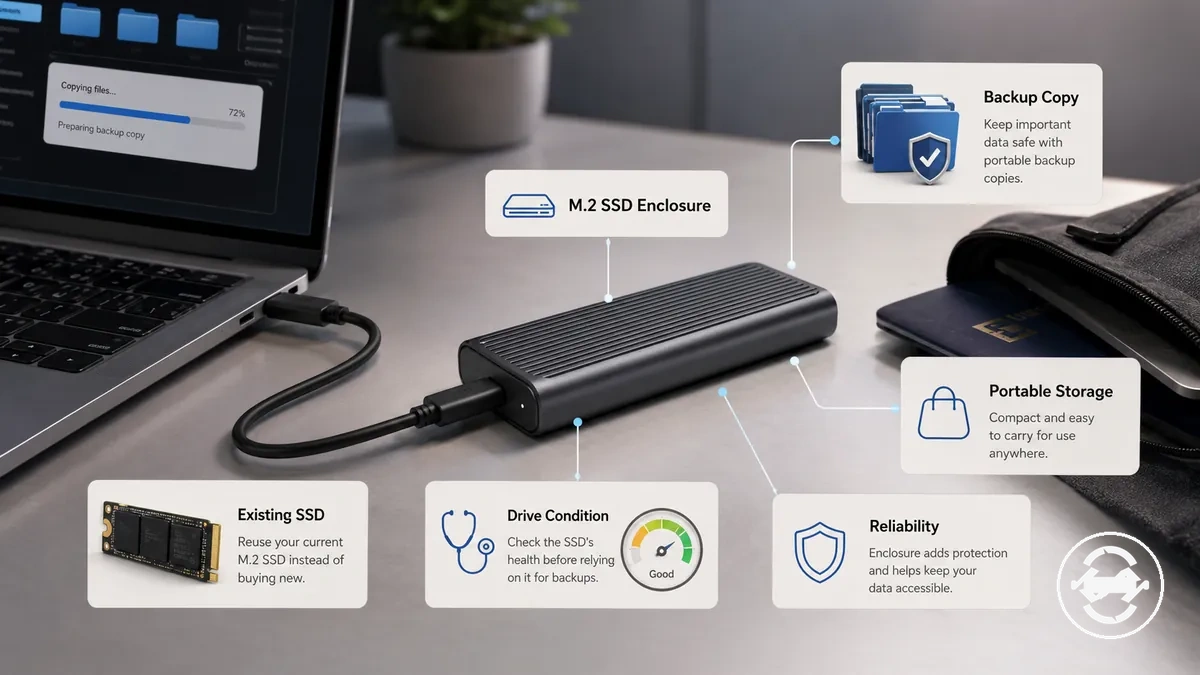
An M.2 SSD enclosure can support different backup use cases, but each situation has different requirements. Portable copies may prioritize convenience, while longer-term storage needs may place more importance on redundancy and reliability practices. The following criteria help separate when an enclosure-based setup fits from when another external storage approach may be more suitable.
| Use case | Requirement | Condition and outcome |
|---|---|---|
| Temporary backup copies | Portable storage and occasional access | Can provide a convenient external storage option when the setup is suitable |
| Existing SSD reuse | Drive condition and compatibility checks | May extend the use of an existing SSD for backup-related tasks |
| Long-term storage needs | Reliability planning and backup redundancy | May require a broader approach than a single enclosure-based drive |
An M.2 SSD enclosure can be useful for portable backup copies, but the enclosure alone does not create a complete backup strategy. Users comparing different storage paths can review an external SSD comparison to understand when a prebuilt external SSD may reduce setup effort or change the trade-offs around handling and portability.
Short-term backup and portable copy jobs
Short-term backup and portable copy jobs are situations where an M.2 SSD enclosure can support temporary data movement or local backup copies. These use cases depend on the copy job type, data size, host device access, file system, and the level of portability and risk the user accepts.
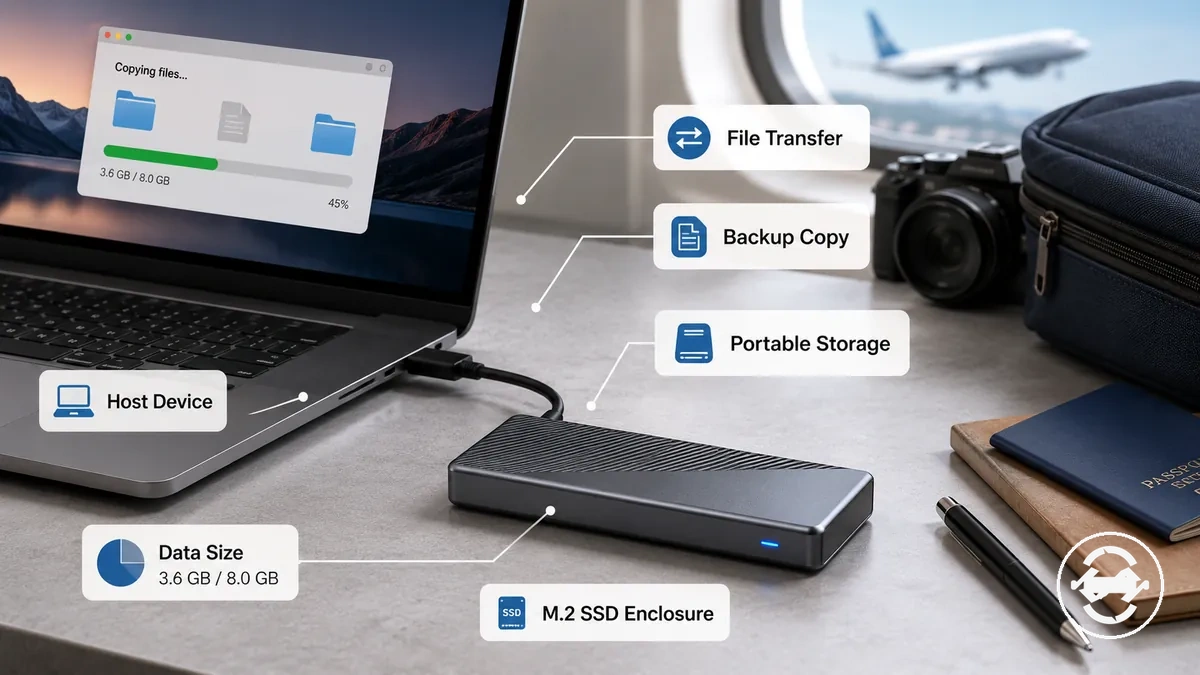
Short-term backup and portable copy jobs often focus on moving data conveniently between devices rather than creating long-term storage protection. Common examples include temporary project copies, device migration staging, or travel backup where a portable enclosure can make file transfer easier when the connection and storage conditions are suitable.
Practical examples of short-term backup and portable copy jobs include:
- Temporary project copies: Moving active files when the data size, transfer needs, and host device support match the task.
- Device migration staging: Holding files during a device move when formatting and file access conditions allow the transfer.
- Travel backup: Carrying a portable backup copy when the M.2 SSD enclosure, cable, and connected device suit the intended use.
An M.2 SSD enclosure used for a short-term copy job should not be treated as permanent data protection. Drive condition, connection stability, file system state, and backup habits can affect the reliability of the outcome.
Repurposing an existing M.2 SSD for backup storage
Repurposing an existing M.2 SSD for backup storage can make sense when the drive condition, capacity, compatibility, and intended copy job match the backup requirements. An M.2 SSD enclosure can turn an existing SSD into portable storage, but the drive should be evaluated before using it for backup copies.
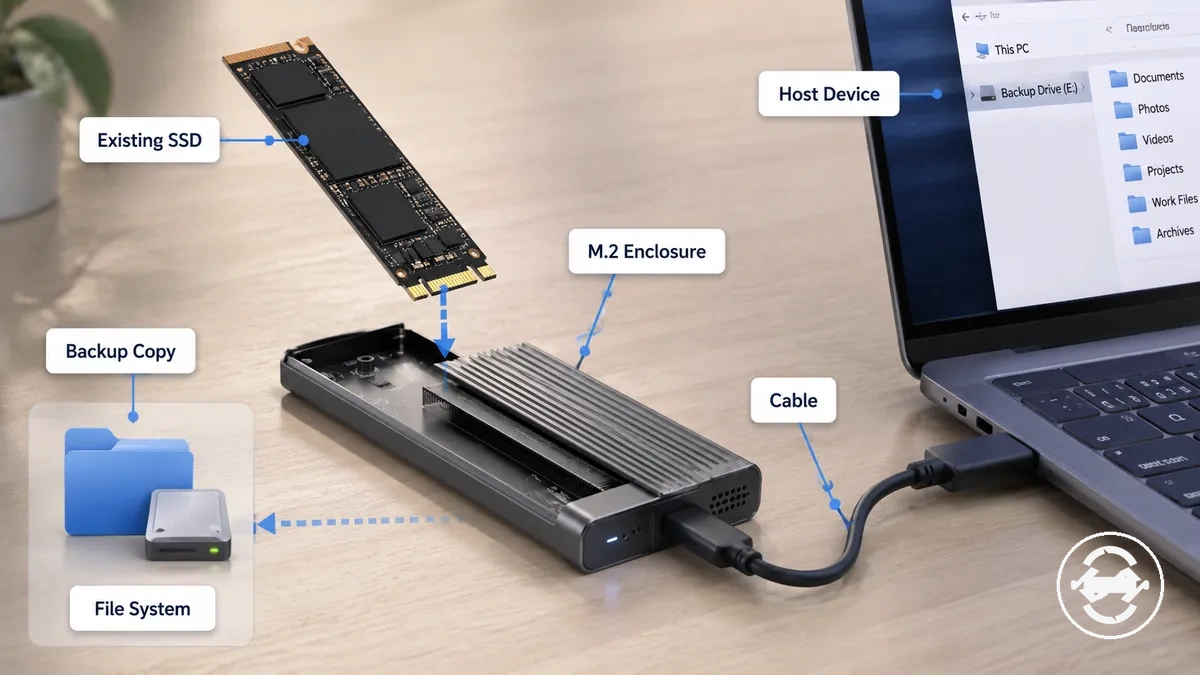
An existing SSD may be useful for portable storage, file transfer, or a backup copy when it suits the workload and connected host device. The M.2 SSD enclosure, cable connection, file system, and formatting status can affect access and write availability. A drive previously used as a system drive may contain partitions or an operating system layout that affects visibility or reuse.
Before using an existing M.2 SSD for backup storage, check the main conditions that affect suitability:
- Drive condition: The SSD should be evaluated based on its current state rather than assumed reliable because an enclosure detects it.
- Capacity: Available storage space should match the data size and backup copy requirements.
- Protocol compatibility: The M.2 SSD type and enclosure support should align for the intended storage use.
- Formatting and file system: The drive may need a suitable partition or file system arrangement for the host device to access it correctly.
An M.2 SSD enclosure can extend the use of an existing drive for backup-related tasks, but drive detection alone does not confirm suitability for every backup purpose. Checking the drive condition and storage setup helps reduce the risk of using an unsuitable drive for important copies.
When a dedicated external SSD is the safer option
A dedicated external SSD may be a simpler choice than an M.2 SSD enclosure when the priority is reducing setup effort, using a prebuilt external drive, or avoiding separate component decisions. The choice depends on factors such as ruggedness, warranty expectations, thermal behavior, and support requirements rather than one option being suitable for every backup situation.
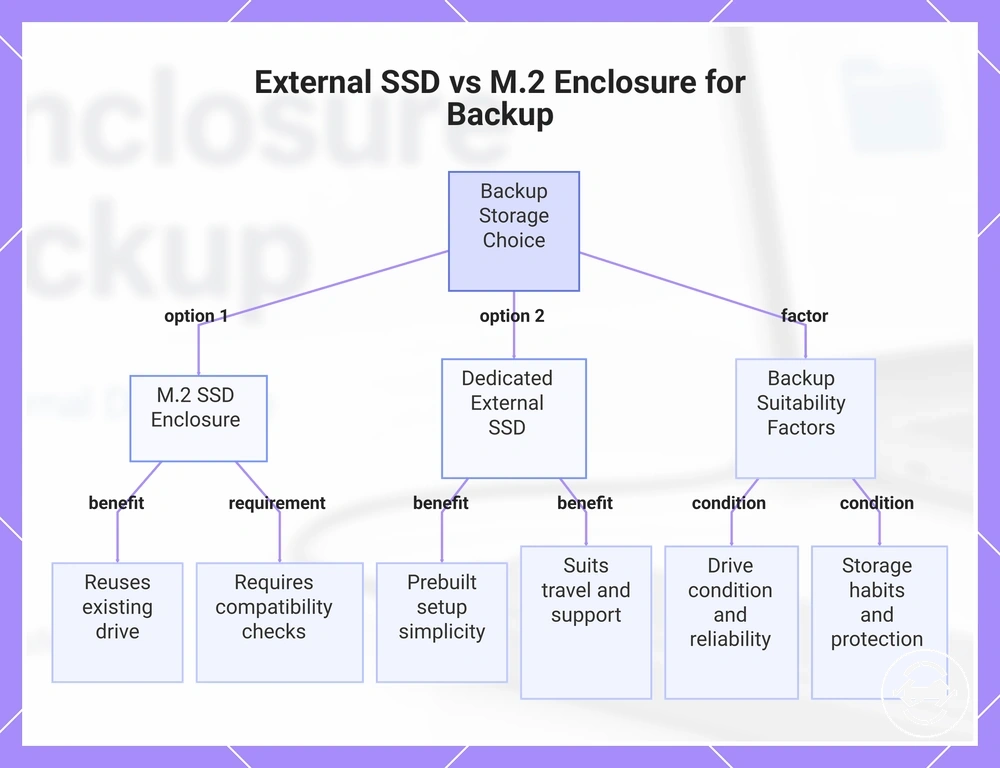
An M.2 SSD enclosure can provide flexibility by allowing reuse of an existing drive, but it requires decisions about the SSD, enclosure compatibility, cable, and connection setup. A dedicated external SSD may suit users who prefer fewer setup steps and a more complete external storage package. The more suitable option depends on whether reuse and customization matter more than simplicity and convenience.
The main trade-offs can be viewed through backup needs and storage priorities:
- M.2 SSD enclosure: May suit users who value existing drive reuse and flexible storage choices when compatibility checks are completed.
- Dedicated external SSD: May suit users who prefer a prebuilt external drive with fewer separate setup decisions and handling requirements.
- Backup suitability: Both approaches depend on drive condition, connection reliability, storage habits, and the level of protection required for the data.
A dedicated external SSD may be simpler when setup effort, travel handling, and support expectations matter more than reusing an existing M.2 drive. An M.2 SSD enclosure remains useful when flexibility is important, but it does not remove the need to consider compatibility and reliability factors.
This chart compares the two backup storage options, highlighting their key attributes and the factors that determine suitability.
When an M.2 SSD enclosure makes sense for file transfer
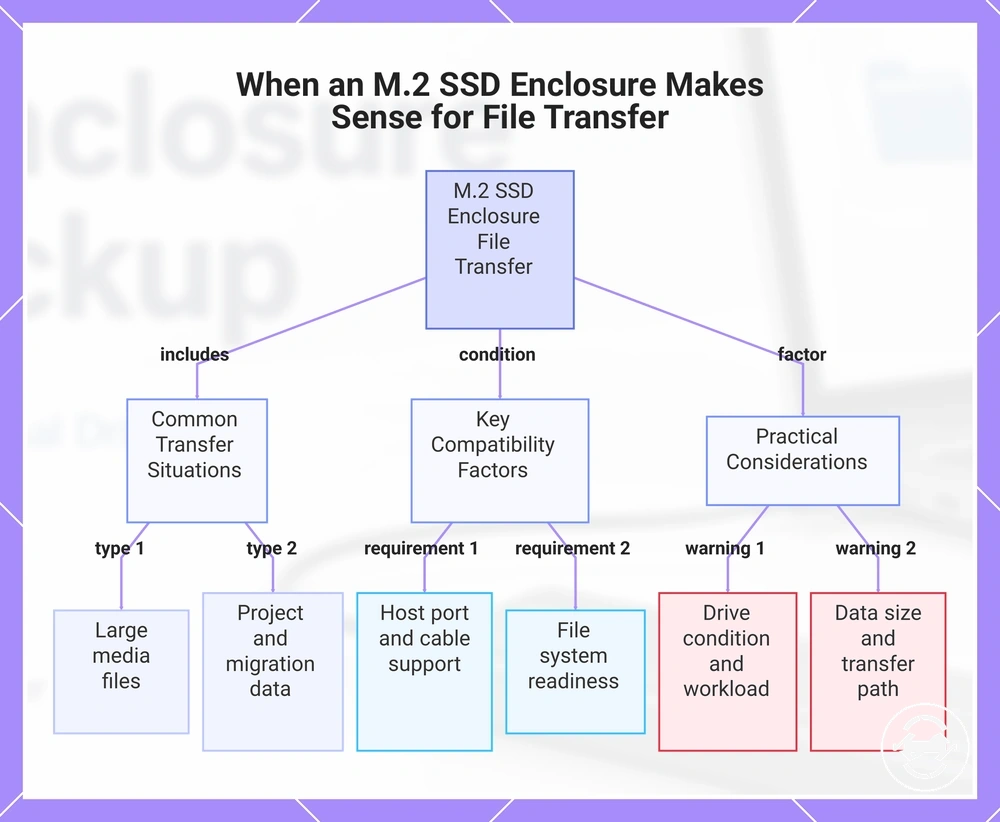
An M.2 SSD enclosure makes sense for file transfer when the task involves moving data between compatible host devices and the storage setup matches the transfer requirements. It can be useful for large files, project folders, backup copies, or migration data when the drive condition, connection path, file system, and portability needs are suitable.
File transfer convenience depends on the transfer task, source and destination devices, USB-C or host port support, and file system readiness. An existing SSD in an M.2 SSD enclosure may provide portable storage for moving files when the enclosure, cable, and connected devices support the intended use case. The outcome can vary based on workload, data size, and the complete transfer path.
Common file transfer situations include:
- Large media files: Moving larger files between compatible devices when the storage path and transfer requirements match.
- Work folders: Carrying project data between host devices when portability and access needs are important.
- Migration support: Moving files during a device change when the file system and connection setup allow access.
An M.2 SSD enclosure can improve convenience for file transfer, but it does not remove the need to consider drive condition, cable and port support, file system compatibility, and workload expectations. These factors can affect whether the transfer setup meets the intended purpose.
This chart shows common use cases, key compatibility factors, and practical considerations for using an M.2 SSD enclosure for file transfer.
Large file movement between computers
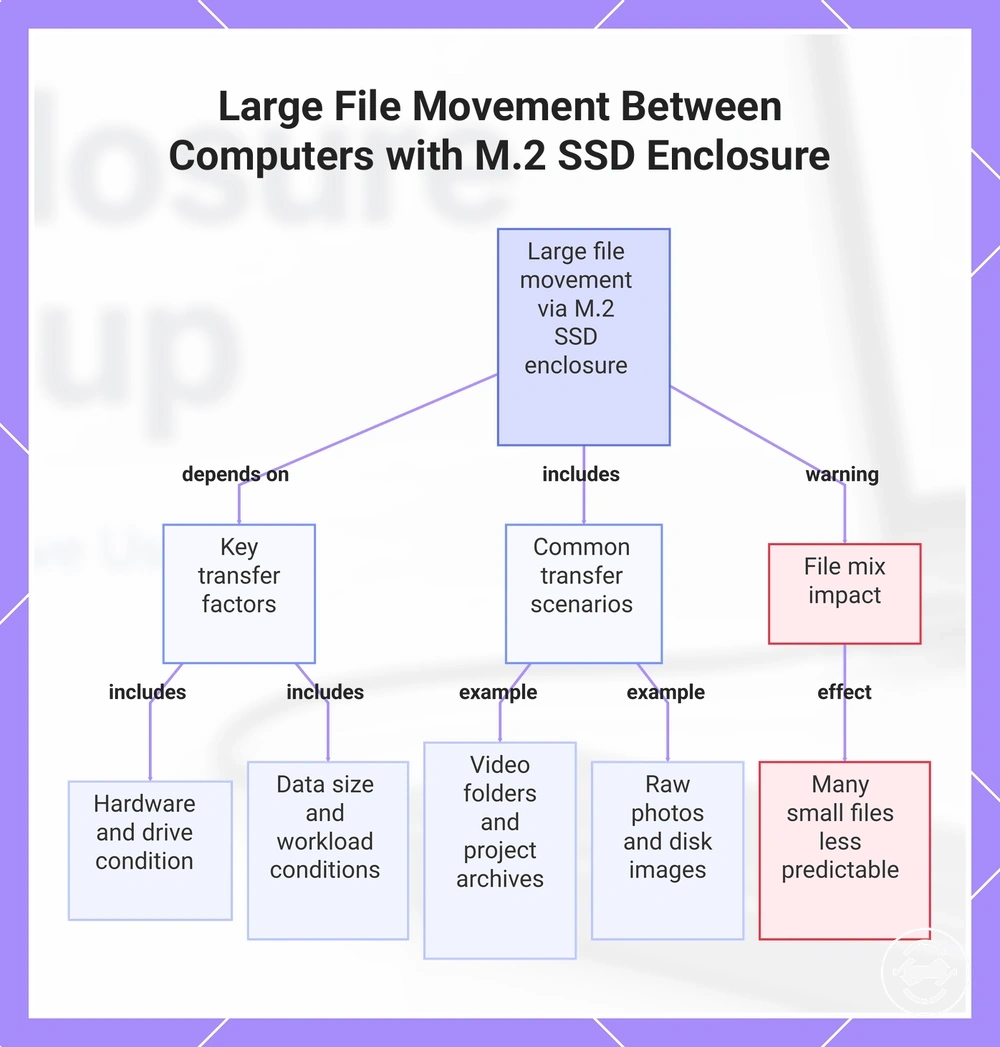
Large file movement between computers is a use case where an M.2 SSD enclosure can help transfer data between compatible devices. Moving video folders, project files, archives, or other large data sets depends on the data size, source and destination devices, connection path, and file system conditions.
A suitable copy job depends on the M.2 SSD enclosure, cable, host device, and storage format working together for the intended transfer. Portable storage can make it easier to move large files when the SSD capability, port support, and workload match the task. The final outcome can vary based on the file mix and the complete transfer path.
Common large file transfer scenarios include:
- Video folders: Moving large media collections when the source device, destination device, and storage setup support the transfer task.
- Project archives: Carrying work files between computers when portable storage and file access are required.
- Raw photos: Transferring large image collections when the data size and file system conditions are suitable.
- Disk images: Moving large storage files when the host devices and transfer setup can access the required data.
Many small files can behave less predictably than one large file with the same total data size because file mix can change copy behaviour. An M.2 SSD enclosure can support large file movement, but transfer results depend on the drive condition, cable, port, host device, and workload.
This chart shows the key factors, common scenarios, and file mix behavior when using an M.2 SSD enclosure to move large files between computers.
Temporary external workspace use
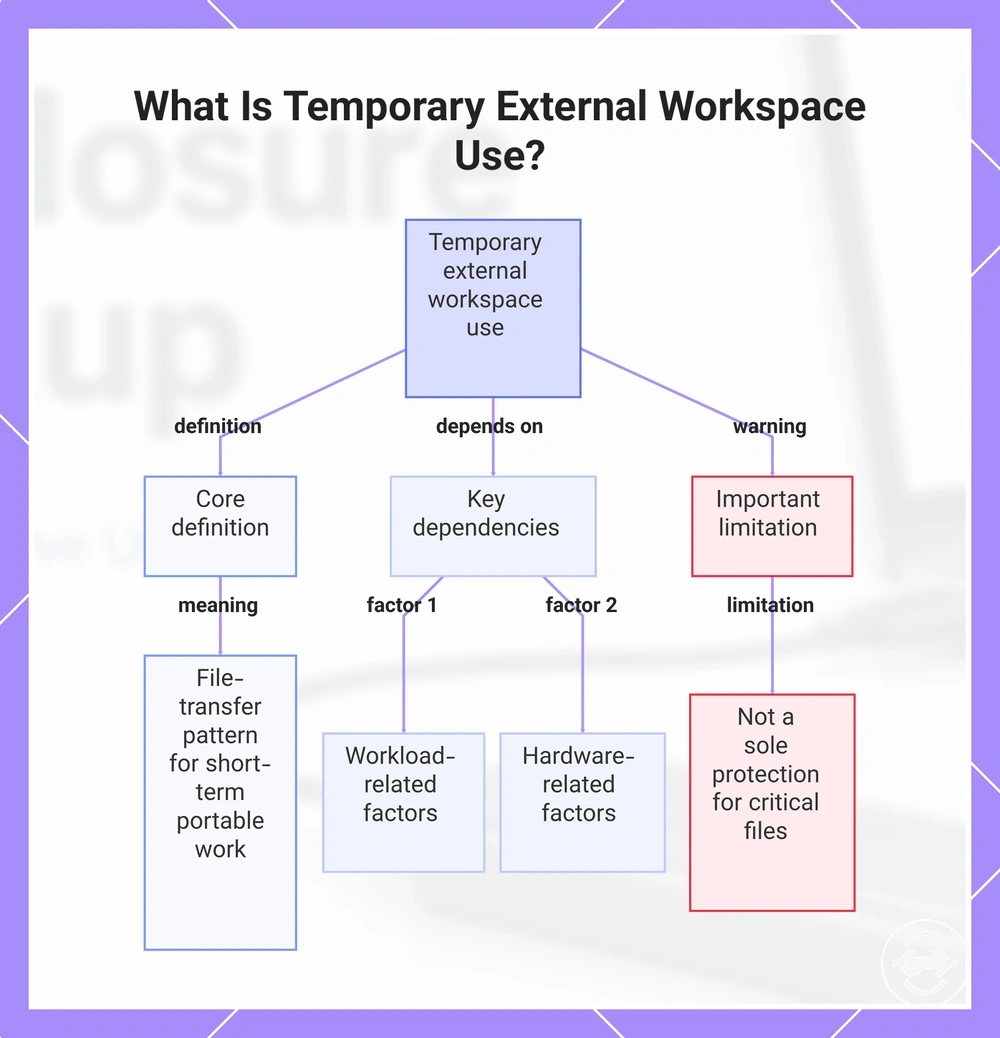
Temporary external workspace use is a file-transfer pattern where an M.2 SSD enclosure can support short-term work from portable storage rather than serve as a permanent workstation solution. This use case depends on the copy job, workload intensity, data size, host device, cable stability, and storage conditions.
An M.2 SSD enclosure may suit active project folders, installers, or temporary media libraries when the read and write activity matches the intended use. Portable storage can provide convenience for moving active files between devices when the file system, transfer path, and host device support the task. Longer or heavier workloads may require more attention to drive condition, heat, connection stability, and workload expectations.
Temporary external workspace examples include:
- Active project folders: Working with portable files when the data size and transfer needs match the enclosure storage setup.
- Installers: Keeping temporary software files available across compatible host devices when file access conditions allow.
- Media libraries: Moving or accessing temporary media collections when workload and connection conditions are suitable.
An M.2 SSD enclosure used as a temporary workspace should not be treated as the only protection layer for critical work. Important files may still require a separate backup copy because enclosure storage used for active work does not replace a broader backup approach.
This chart shows the definition, key dependencies, and important warning for using an M.2 SSD enclosure as a temporary external workspace.
Cloning and migration as transfer workflows
Cloning and migration are transfer workflows where an M.2 SSD enclosure may provide a temporary connection path between storage devices. These workflows depend on the source drive, target drive, data size, capacity, partition layout, file system, software method, and the expected outcome of the transfer.
A copy job, drive clone, and bootable migration are different results that require different conditions. An M.2 SSD enclosure can support portable storage and transfer tasks when the host device, drive compatibility, and connection setup match the intended workflow. The outcome can vary based on the target capacity, existing drive structure, and transfer method.
A simplified workflow can be organized around these checks:
- Source and target drives: Check drive capacity and compatibility with the intended transfer outcome.
- Drive structure: Consider partition layout and file system conditions because existing storage organisation can affect reuse.
- Transfer method: The chosen method affects whether the result is a file copy, drive clone, or migration workflow.
An M.2 SSD enclosure can provide a useful transfer path for cloning or migration tasks, but it does not make every transfer outcome the same. Boot expectations, drive condition, and system requirements should be considered separately from a standard file transfer.
Setup conditions before using the enclosure
An M.2 SSD enclosure depends on correct setup conditions before it can be recognised and used for backup or transfer tasks. The enclosure, drive support, formatting, cable, port, and host device must align for the storage path to provide a suitable outcome.
Before using an M.2 SSD enclosure, check the drive type, NVMe or SATA support, key notch, length, connection cable, host port, and file system state. Each attribute can affect whether the drive is detected, writable, limited, or unsuitable for the intended use. The physical match between the enclosure and drive is only one part of the complete setup.
The main conditions can be organised by the part being checked and its practical effect:
| Entity/part | Attribute/criterion | Value/condition | Effect/risk/decision |
|---|---|---|---|
| M.2 SSD enclosure | Drive type support | Must match the internal M.2 drive type, such as NVMe or SATA | Can affect whether the drive is recognised and usable |
| Internal M.2 drive | Key notch and length | Must align with the enclosure design | Mismatch may limit use or prevent proper connection |
| Cable and port | Connection path | Depends on cable condition, port support, and host device compatibility | Can influence recognition, transfer, and stability |
| File system | Formatting state | May require preparation before access | Can affect visibility and write access |
Preparing the storage state is another setup consideration, and formatting before use can affect how the drive is accessed. Checking these conditions first helps identify whether the enclosure setup is detected, usable, or limited for the intended backup or transfer task.
Drive type, key, and size support
Drive type, key notch, and size support determine whether an M.2 SSD enclosure can accept and use a specific M.2 SSD. Physical fit alone is not enough because the enclosure controller must also support the drive protocol and requirements.
Physical fit and protocol support are separate checks when preparing an M.2 SSD enclosure for use. The M.2 SSD drive type, such as NVMe or SATA, must align with the enclosure support, while the key notch and length must match the physical design. A drive may fit inside an enclosure but still be unsupported if the controller does not support the required protocol.
The main compatibility checks can be organised by the drive attributes and their practical effect:
- Drive type: NVMe or SATA support should match the enclosure controller requirements for the intended use.
- Key notch: The M.2 SSD key layout should align with the enclosure connection design.
- Length: The SSD size should match the physical dimensions supported by the enclosure.
- File system: The storage format can affect whether the host device can access and write to the drive.
Checking these attributes helps separate physical compatibility from actual usability. An M.2 SSD enclosure can provide access to a drive only when the protocol support, physical design, and host device conditions align.
Formatting and file system requirements
Formatting and file system requirements determine whether a detected M.2 SSD enclosure setup becomes usable storage for backup or file transfer. A drive can be recognised by the host device but still require a suitable storage structure before it provides normal write access and transfer usability.
The drive state affects how portable storage is accessed across devices. An M.2 SSD enclosure setup may depend on whether the drive is initialized, partitioned, and formatted, while the selected file system can influence host device visibility and file handling. New drives, erased drives, or previously internal system drives may require different preparation before reuse.
The main storage conditions can be viewed through the drive state and practical effect:
| Drive state | Condition | Practical effect |
|---|---|---|
| Initialized drive | Storage structure is recognised by the host device | Allows the drive to be prepared for storage access |
| Partitioned drive | Storage space has an organised layout | Can affect visibility and how the host device accesses the drive |
| Formatted drive | File system is available for storage operations | Influences write access and file transfer usability |
File system choice can affect cross-device access when moving files between compatible host devices. Formatting decisions depend on the intended transfer or backup copy use case, so the setup should match the required access conditions without extending into recovery or advanced troubleshooting.
Cable, port, and host device requirements
Cable, port, and host device requirements determine whether an M.2 SSD enclosure is recognised and usable for backup or transfer tasks. The connection layer affects recognition, power behaviour, and transfer results, so the cable and host connection must support the intended storage use case.
The M.2 SSD enclosure relies on the cable, port, and host device working together for stable access. Connector type, USB or Thunderbolt support, power delivery, and host operating system behaviour can affect whether the enclosure is detected, limited, or unstable. A USB-C connector alone does not define the same speed, protocol, or compatibility across every cable and port combination.
The main connection checks can be organised by the part being verified and its practical effect:
- Cable: Cable type and condition can influence enclosure recognition and transfer behaviour.
- Port: Port support can affect connection stability, available power, and transfer capability.
- Host device: Host operating system and device support can affect drive recognition and file access.
- Adapters and front-panel ports: Additional connection paths may create inconsistent recognition or reduced transfer behaviour in some setups.
A suitable connection path still depends on the complete setup, including the M.2 SSD enclosure, cable, port, host device, and file system conditions. Checking these factors helps separate connection limitations from drive or storage issues.
Transfer speed expectations for backup and file movement
Transfer speed for backup and file movement depends on the slowest part of the storage path rather than the M.2 SSD enclosure alone. Rated speed, SSD capability, cable rating, host port, file mix, and thermal state all influence real-world copy speed expectations.
Real-world speed depends on how the enclosure, drive, and connection path work together. For additional context, transfer speed expectations can be considered alongside rated speed, SSD capability, cable rating, and host port conditions. A rated speed value does not automatically represent every copy job because workload and device conditions can change the outcome.
The main speed-related conditions can be organised by the storage path element and its practical effect:
| Entity/part | Attribute/criterion | Value/condition | Effect/risk/decision |
|---|---|---|---|
| M.2 SSD enclosure | Rated speed | Depends on enclosure design and supported connection conditions | Can influence the upper limit of transfer behaviour |
| SSD | SSD capability | Varies by drive condition and workload | Can affect copy speed and sustained transfer behaviour |
| Cable and host port | Cable rating and port support | Must align with the connection path | Can create a bottleneck when limited |
| Files | File mix and data size | Large files and many small files can behave differently | Changes practical copy performance expectations |
| Thermal state | Heat during workload | Depends on activity level and device conditions | Can influence longer transfer behaviour |
Backup copies, single large files, and folders with many small files can produce different transfer results. A large file may copy differently from many smaller files with the same total data size, so workload, device condition, and connection path should shape expectations.
What controls real-world copy speed
Real-world copy speed depends on the part of the storage path that becomes the bottleneck during a transfer. An M.2 SSD enclosure, SSD capability, cable rating, host port, file mix, and thermal state can each affect transfer speed and copy performance.
Each variable can change the outcome depending on the workload and connection path. Checking the main speed-related attributes helps identify whether the limitation comes from the drive, enclosure, connection, files, or operating conditions.
The main variables can be organised by attribute, condition, and practical effect:
| Entity/part | Attribute/criterion | Value/condition | Effect/risk/decision |
|---|---|---|---|
| SSD | SSD capability and drive type | Depends on NVMe or SATA capability and drive condition | Can influence transfer speed and copy speed |
| M.2 SSD enclosure | Controller and connection mode | Depends on enclosure design and supported interface | Can limit the available transfer path |
| Cable and host port | Cable rating and port support | Must align with the connection path | Can become a bottleneck when limited |
| Files | File mix and workload | Large files and many small files can behave differently | Changes copy performance expectations |
| Thermal state | Heat during workload | Depends on transfer duration and device conditions | Can affect sustained transfer behaviour |
If copy speed is lower than expected, checking the cable and host port first can help identify connection limits before reviewing other variables. The final result depends on the complete setup, including drive condition, workload, and transfer path.
Why rated enclosure speed and file transfer speed differ
Rated enclosure speed and file transfer speed are different measurements because rated speed describes interface capability, while copy speed reflects the full storage workload. An M.2 SSD enclosure rating shows a connection ceiling, but the observed transfer result depends on SSD capability, file mix, cable rating, host port, and thermal state.
The difference appears because the transfer path includes more than the enclosure interface. A rated speed value represents the supported connection condition, while real-world speed reflects SSD behaviour, system overhead, and how data is moved. A single large file may copy differently from many small files because the workload pattern changes the practical copy performance.
The contrast can be viewed through these speed factors:
- Rated interface speed: Represents the theoretical ceiling of the enclosure connection capability.
- File workload: Shows how file mix, data size, and copy conditions influence practical transfer speed.
- System overhead: Includes the effects of the SSD, host device, connection path, and storage operations on the observed result.
Transfer speed should be evaluated as a complete system outcome rather than only by the M.2 SSD enclosure rating. The final copy speed depends on the use case, drive condition, workload, and connection conditions.
Reliability risks during repeated backup and transfer use
Repeated backup and transfer use with an M.2 SSD enclosure can introduce reliability risks when heat, cable movement, unsafe removal, or an unstable port interrupts storage activity. Reliability depends on thermal behaviour, connection stability, and safe handling during write activity rather than the enclosure alone.
During repeated use, the storage path can be affected by workload length, drive condition, and connection behaviour. Heat during longer transfers, cable movement, or an unstable port may contribute to transfer interruption or reduced backup reliability. These conditions do not mean every disconnect indicates device failure, but they can signal that the setup should be reviewed.
The main reliability factors can be organised by risk source, condition, and possible effect:
| Risk source | Condition or symptom | Possible effect |
|---|---|---|
| Heat | Extended workload or sustained write activity | May affect transfer consistency during longer use |
| Cable movement | Connection changes while transferring data | Can contribute to transfer interruption |
| Unstable port | Inconsistent recognition by the host device | May affect drive availability during use |
| Unsafe removal | Drive disconnected during active writes | Can create risks for backup integrity or file access |
Everyday storage care, such as maintaining connection stability and using safe eject practices, is separate from diagnosing slower transfer behaviour. For deeper performance investigation, see slow transfer troubleshooting as a separate troubleshooting path.
Heat, throttling, and long transfer sessions
Long transfer sessions can create reliability considerations for an M.2 SSD enclosure when sustained write activity increases heat or exposes thermal limits. Heat and throttling behaviour depend on the enclosure design, SSD workload, airflow, and transfer duration rather than warmth alone indicating a failure.
An M.2 SSD enclosure and SSD can respond differently during extended backup or transfer tasks. Enclosure material, thermal pad contact, SSD workload, ambient airflow, and long write activity can influence thermal behaviour. Large backups that run for extended periods may reveal thermal limits that are not visible during shorter transfers.
The main heat-related factors can be organised by attribute, condition, and possible effect:
| Attribute | Condition | Possible effect |
|---|---|---|
| Enclosure material | Different enclosure designs manage heat differently | Can influence heat behaviour during longer transfers |
| Thermal pad contact | Depends on contact between components and enclosure structure | Can affect heat management during activity |
| SSD workload | Sustained write activity continues over time | May contribute to throttling behaviour |
| Ambient airflow | Surrounding conditions affect heat dissipation | Can influence longer transfer sessions |
| Transfer duration | Large backups or long writes increase activity time | May expose thermal limits during extended use |
Warm operation during activity does not automatically indicate a problem. Maintaining stable connections, avoiding unnecessary cable movement, using safe eject practices, and monitoring activity light behaviour can help reduce disconnection risk during write activity.
Safe eject, activity lights, and disconnection risk
Safe eject, activity lights, and stable connections help reduce disconnection risk when using an M.2 SSD enclosure for backup or transfer. Write activity can continue after a copy window appears finished, so removal depends on the host device state and storage activity rather than appearance alone.
Handling practices during active transfers can affect backup integrity and transfer completion. The activity light, operating-system eject behaviour, cable movement, and port stability provide signals that help reduce interruption risk. These checks support enclosure care, but a disconnect does not automatically mean complete drive failure.
The main handling conditions can be organised by condition, risk, and safer action:
- Activity light: Continued activity may indicate ongoing storage operations, so waiting before removal can help avoid interrupting write activity.
- Safe eject: Using the operating-system eject process can help confirm that active transfers have completed before disconnecting.
- Cable movement: Movement during a transfer can increase disconnection risk, so stable handling is preferred.
- Port stability: An unstable connection may affect recognition or transfer completion, so a consistent connection can help reduce interruption risk.
Unplugging an M.2 SSD enclosure during active writes can interrupt backup completion or affect transferred files. Safe eject and careful handling address everyday use, while other connection or performance issues may require separate checks.
Choosing an enclosure for backup and file transfer use
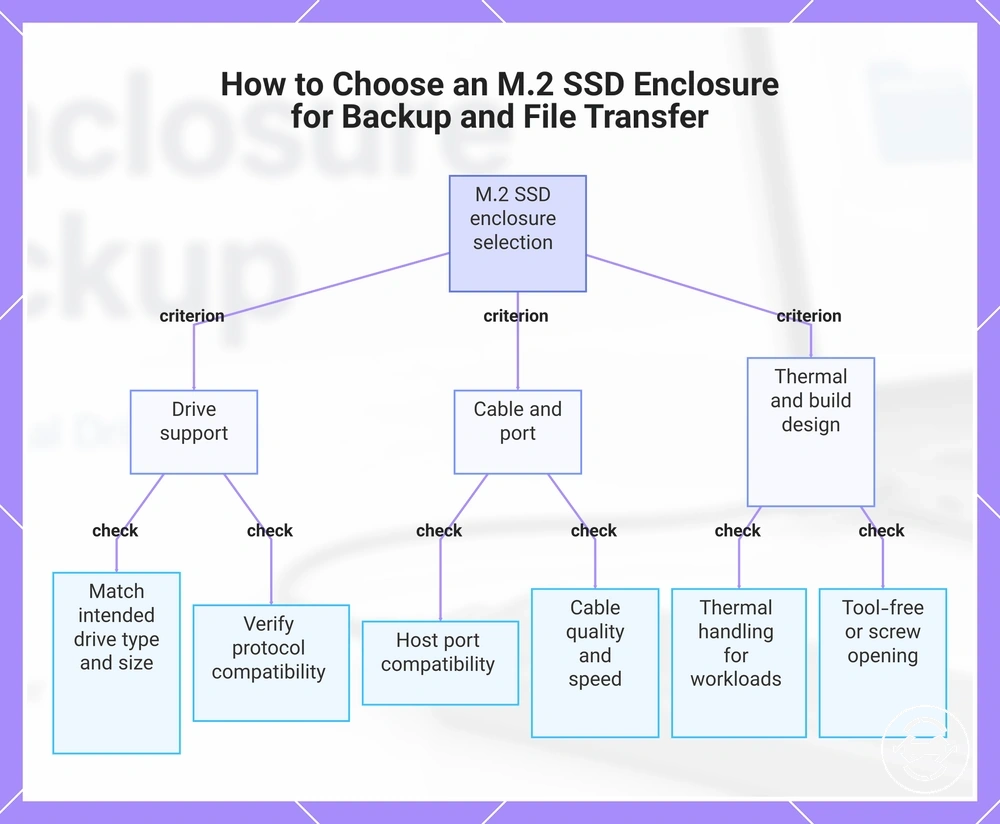
The right M.2 SSD enclosure for backup and file transfer depends on matching the drive, host devices, workload, speed needs, and reliability expectations. An enclosure choice should fit the intended use case rather than rely on one feature being suitable for every situation.
Selection should follow compatibility, speed, and reliability criteria already established for the storage setup. Important factors include drive support, supported protocol, size support, port standard, cable availability, thermal design, build quality, warranty considerations, and the opening method used for installation and handling.
The main selection checks can be organised by feature and practical outcome:
- Drive support: The M.2 SSD enclosure should support the intended drive type, size, and protocol requirements for the planned backup or file transfer use.
- Cable and port: The cable and host port can influence connection compatibility, recognition, and transfer behaviour across devices.
- Thermal design: Enclosure thermal design can affect handling during repeated transfers or longer workloads.
- Build quality and opening method: Build quality and tool-free or screw-based designs can affect enclosure handling and setup preferences.
For occasional backup, a simple enclosure option that matches drive support and connection needs may be suitable. Frequent large transfers may require more attention to thermal design, speed rating, and repeated transfer handling, while repurposed SSD use may place more importance on compatibility and enclosure fit. A broader M.2 SSD enclosure guide can help organize these criteria before selecting an enclosure option.
Here are product examples that may make comparison easier. Before buying, always review the compatibility criteria, essential features, and product details.
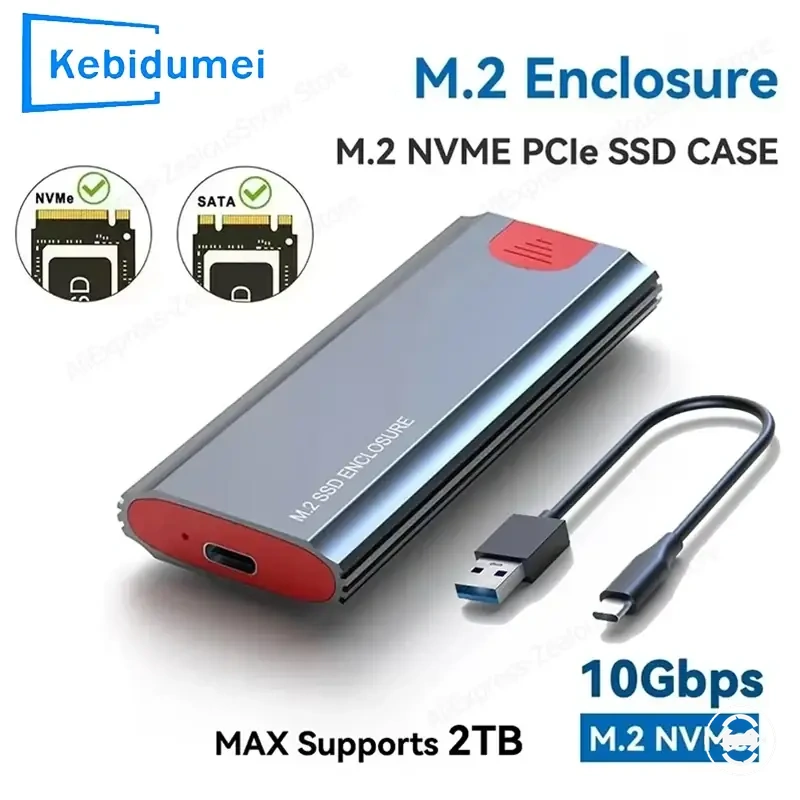
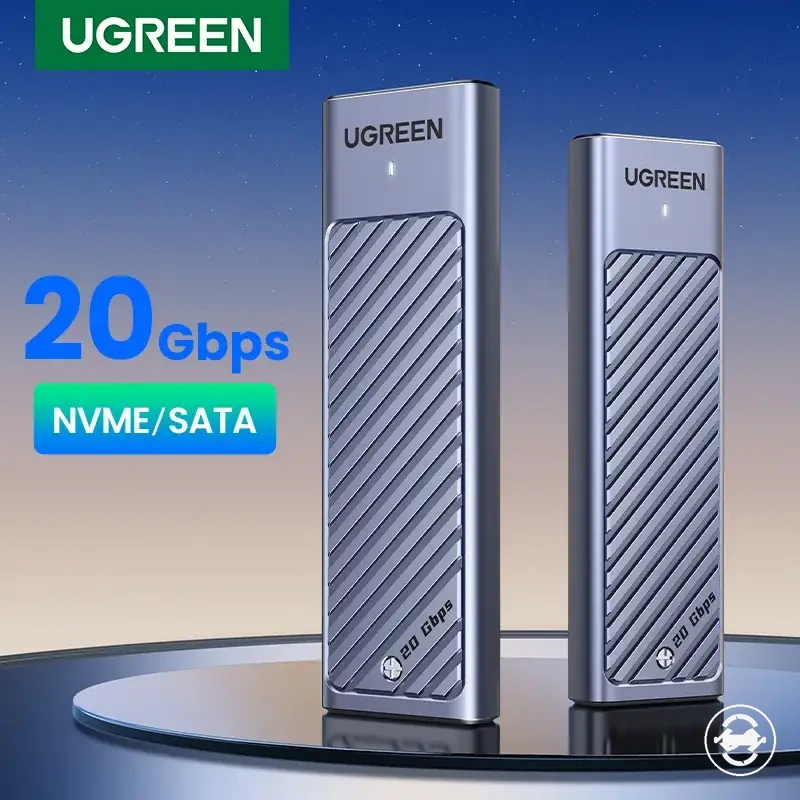
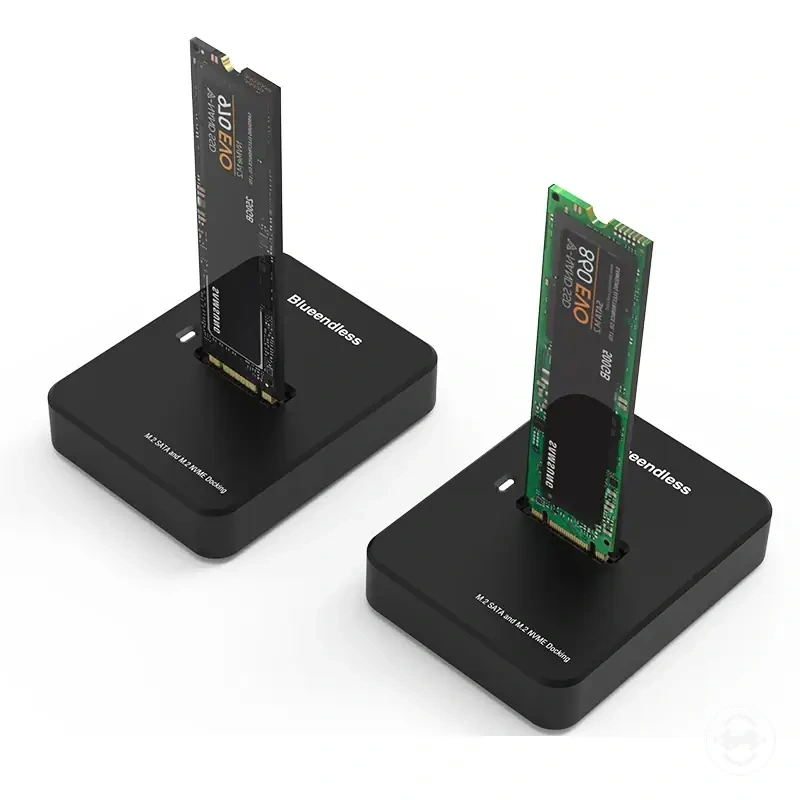
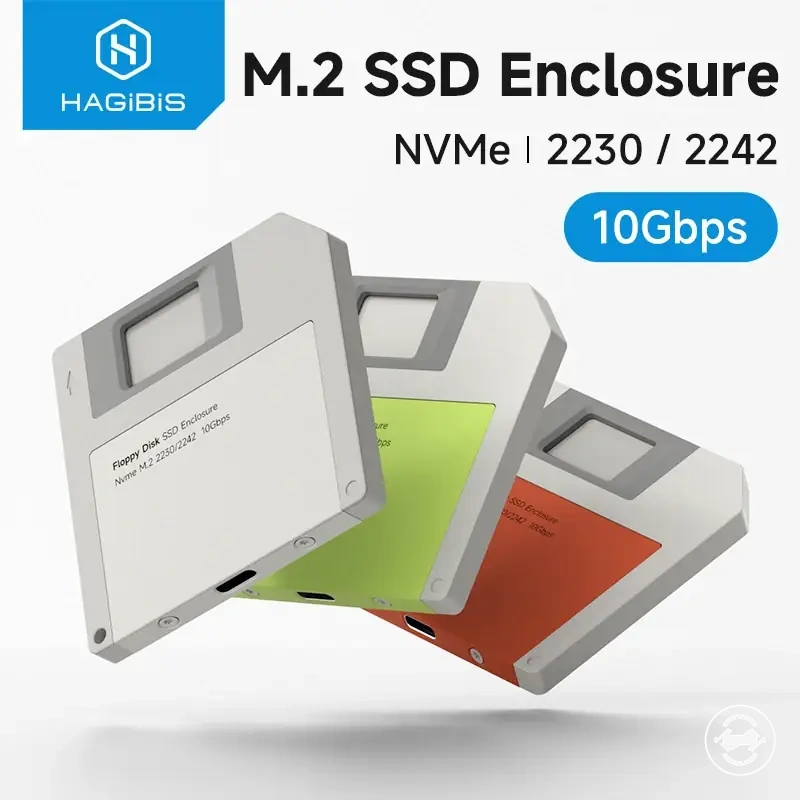
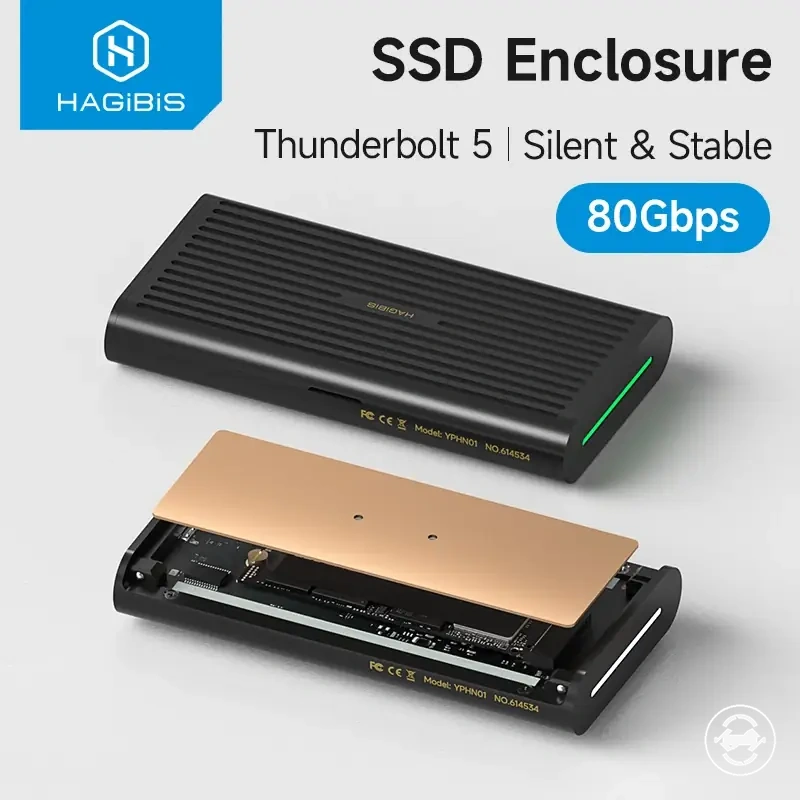
This chart outlines the main selection criteria for an M.2 SSD enclosure, organized by drive support, cable and port compatibility, and thermal and build design.